RH1657 - DVD player LG - Free user manual and instructions
Find the device manual for free RH1657 LG in PDF.


User questions about RH1657 LG
0 question about this device. Answer the ones you know or ask your own.
Ask a new question about this device
Download the instructions for your DVD player in PDF format for free! Find your manual RH1657 - LG and take your electronic device back in hand. On this page are published all the documents necessary for the use of your device. RH1657 by LG.
USER MANUAL RH1657 LG
Before connecting, operating or adjusting this product, please read this instruction booklet carefully and completely.
HDD
HARD DISK DRIVE
DVD
VIDEO/RW/R
RW
COMPATIBLE
RW
DVD+ReWritable


DOLBY
DIGITAL



The Clear Choice In Digital Video™

CAUTION RISK OF ELECTRIC SHOCK DO NOT OPEN

CAUTION: TO REDUCE THE RISK
OF ELECTRIC SHOCK
DO NOT REMOVE COVER (OR BACK)
NO USER-SERVICEABLE PARTS INSIDE EFER SERVICING TO QUALIFIED SERVICE PERSONNEL.

This lightning flash with arrowhead symbol within an equilateral triangle is intended to alert the user to the presence of uninsulated dangerous voltage within the product's enclosure that may be of sufficient magnitude to constitute a risk of electric shock to persons.

The exclamation point within an equilateral triangle is intended to alert the user to the presence of important operating and maintenance (servicing) instructions in the literature accompanying the product.
WARNING: TO PREVENT FIRE OR ELECTRIC SHOCK HAZARD, DO NOT EXPOSE THIS PRODUCT TO RAIN OR MOISTURE.
CAUTION:
Do not block any ventilation openings. Install in accordance with the manufacturer's instructions.
Slots and openings in the cabinet are provided for ventilation and to ensure reliable operation of the product and to protect it from over heating.
The openings should be never be blocked by placing the product on a bed, sofa, rug or other similar surface. This product should not be placed in a built-in installation such as a bookcase or rack unless proper ventilation is provided or the manufacturer's instruction have been adhered to.

CAUTION:
CLASS 2M VISIBLE AND INVISIBLE LASER RADIATION WHEN OPEN AND INTERLOCKS DEFEATED DO NOT STARE INTO THE BEAM OR VIEW DIRECTLY WITH OPTICAL INSTRUMENTS.
CAUTION:
This product employs a Laser System.
To ensure proper use of this product, please read this owner's manual carefully and retain it for future reference. Should the unit require maintenance, contact an authorized service center.
Performing controls, adjustments, or carrying out procedures other than those specified herein may result in hazardous radiation exposure.
To prevent direct exposure to laser beam, do not try to open the enclosure. Visible laser radiation when open. DO NOT STARE INTO BEAM.
CAUTION: The apparatus should not be exposed to water (dripping or splashing) and no objects filled with liquids, such as vases, should be placed on the apparatus.
CAUTION concerning the Power Cord
Most appliances recommend they be placed upon a dedicated circuit;
That is, a single outlet circuit which powers only that appliance and has no additional outlets or branch circuits. Check the specification page of this owner's manual to be certain.
Do not overload wall outlets. Overloaded wall outlets, loose or damaged wall outlets, extension cords, frayed power cords, or damaged or cracked wire insulation are dangerous. Any of these conditions could result in electric shock or fire. Periodically examine the cord of your appliance, and if its appearance indicates damage or deterioration, unplug it, discontinue use of the appliance, and have the cord replaced with an exact replacement part by an authorized servicer.
Protect the power cord from physical or mechanical abuse, such as being twisted, kinked, pinched, closed in a door, or walked upon. Pay particular attention to plugs, wall outlets, and the point where the cord exits the appliance.
To disconnect power from the mains, pull out the mains cord plug. When installing the product, ensure that the plug is easily accessible.

Disposal of your old appliance
- When this crossed-out wheeled bin symbol is attached to a product it means the product is covered by the European Directive 2002/96/EC.
- All electrical and electronic products should be disposed of separately from the municipal waste stream via designated collection facilities appointed by the government or the local authorities.
- The correct disposal of your old appliance will help prevent potential negative consequences for the environment and human health.
- For more detailed information about disposal of your old appliance, please contact your city office, waste disposal service or the shop where you purchased the product.
CE This product is manufactured to comply with the radio interference requirements of EEC DIRECTIVE 89/336/EEC, 93/68/EEC and 73/23/EEC.
Contents
Introduction 4-9
Symbol Used in this Manual 4
Notes on Discs 4
Recordable and Playable Discs .....5
Playable Discs 6
Regional Code 6
Availability of copying or moving feature .....6
About the internal hard disk drive .....7
Front Panel 8
Remote Control 9
Remote Control Operation 9
Hookup and Settings .....10-22
Rear Panel 10
Connecting to the Aerial 10
Connections to Your TV 11
Connecting to an Amplifier .....12
Accessory Audio/Video (A/V) Connections ..13-14
Using the Home Menu 15
Initial Settings 15
General Operation 15
General Settings 15-18
Auto Programming 15
Program Edit 16
Auto Clock Set / Manual Clock Set .....17
TV Aspect / Display Mode .....17
Progressive Scan 17
AV2 Connection / Power Save Mode .....17
Initialization 18
Language Settings 18
Audio Settings 18
Dolby Digital / DTS / MPEG .....18
Sampling Frequency 18
DRC (Dynamic Range Control) 18
Vocal 18
Lock (Parental Control) Settings .....19
Rating / Set Password / Area Code .....19
DivX Registration Code 19
Recording Settings 20
Record Mode Set / Record Aspect .....20
DV Recording Audio / TV Recording Audio .20
Auto Chapter / AV2 Recording .....20
Disc Settings 20-21
Disc Format 20
Finalize / Disc Label .....21
Disc Protect / PBC .....21
General Explanation of On-Screen Display ....22
Playback 23-33
General Playback Features .....23-26
Playing a DivX Movie File .....27
Playing an Audio CD or MP3/WMA file .....28
Program Playback with Audio CD and
MP3/WMA file 29
Viewing a JPEG File 30-31
Editing a MP3/WMA, JPEG, DivX file .....32-33
Recording 34-40
About DVD recording .....34
About HDD recording .34
Timeshift 35
Basic Recording from a TV .36
Instant Timer Recording ....36
Timer Recording 37
Checking Timer Recording Details .....38
Recording from an External Input ....38
Recording from DV Input 39
Simultaneous recording and playback .....40
Playback another title during recording ....40
Time Slip 40
Editing 41-48
Title List and Chapter List Menu Overview ....41
HDD, VR Mode: Original and Playlist Editing ...42
Adding Chapter Markers 42
Changing Title Thumbnails .42
Making a New Playlist....43
Adding Additional Title/Chapters to the Playlist .43
Deleting an Original or Playlist Title/Chapter . . .44
Deleting a Part 44
Naming a Title 45
Time Search 45
Sort 46
Undoing/Redoing the Last Deletion .....46
Combining Two Titles Into One 46
Divide One Titles Into Two 47
Combining Two Chapters Into One .....47
Moving a Playlist Chapter .48
Hide a Chapter/Title 48
Protect a Title .48
Dubbing 49-51
Before Dubbing 49
Dubbing from HDD to DVD .50
Dubbing from DVD to HDD .50
One Touch Copy (HDD to DVD) .....51
One Touch Copy (DVD to HDD) .....51
Reference 52-57
Additional Information .....52
Overwriting Recording .52
Viewing Title List menu displayed on other
DVD Recorders or Players .....52
Playing Your Recordings on Other DVD
Players (Finalizing a Disc) .....52
Language Codes ....53
Area Codes .53
Controlling Your TV with the Supplied
Remote Control 54
Troubleshooting .....55-56
Specifications 57
Introduction
To ensure proper use of this product, please read this owner's manual carefully and retain for future reference.
This manual provides information on the operation and maintenance of your recorder. Should the unit require service, contact an authorized service location.
About the ⊙ Symbol Display
“∅” may appear on your TV display during operation and indicates that the function explained in this owner's manual is not available on that specific media.
Symbol Used in this Manual
Note:
Indicates special notes and operating features.
Tip:
Indicates tips and hints for making the task easier.
A section whose title has one of the following symbols are applicable only to the disc represented by the symbol.
HDD Titles recorded on the HDD
DVD ALL All DVD discs listed below.
-RWVR DVD-RW with VR recording mode
-RWvideo DVD-RW with Video recording mode
+RW DVD+RW disc
-R DVD-R disc
+R DVD+R (DL) disc
DVD DVD-Video disc
VCD Video CDs
ACD Audio CDs
DivX DivX files
MP3 MP3 files
WMA WMA files
JPEG JPEG files
Notes on Discs
Handling Discs
Do not touch the playback side of the disc. Hold the disc by the edges so that fingerprints do not get on the surface. Never stick paper or tape on the disc.


Storing Discs
After playing, store the disc in its case. Do not expose the disc to direct sunlight or sources of heat and never leave it in a parked car exposed to direct sunlight.
Cleaning Discs
Fingerprints and dust on the disc can cause poor picture quality and sound distortion. Before playing, clean the disc with a clean cloth. Wipe the disc from the center out.
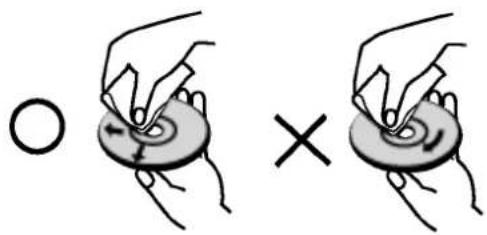
natural_image
Illustration of two hands holding a circular object with a cross symbol (no text or labels)Do not use strong solvents such as alcohol, benzine, thinner, commercially available cleaners, or anti-static spray intended for older vinyl records.
Moisture Condensation
Never operate this product immediately after moving it from a cold location to a warm location. Leave it for two or three hours without operating it. If you use this product in such a situation, it may damage discs and internal parts.
Recordable and Playable Discs

DVD-RW (Digital Video Disc - ReWritable):
- DVD-RW discs can be formatted for VR mode recording or Video mode recording. - These Discs can be recorded on repeatedly. Recordings can be erased, then you can record again on the same Disc.
[VR mode]
• Recordings can be extensively edited
- Playable only on VR mode compatible players (after finalization)
[Video mode]
- Playable on regular DVD players (after finalization)
• Limited editing features

DVD-R (Digital Video Disc - Recordable)
• These Discs can be recorded only once. After you finalize a DVD-R, you cannot record on it or edit it.
• DVD-R discs can be only formatted to Video mode.
- Playable on regular DVD players (after finalization)
- Limited editing features

DVD+RW (Digital Video Disc + ReWritable)
- These Discs can be recorded on repeatedly. Recordings can be erased, then you can record again on the same Disc.
- Playable on DVD+RW compatible players (automatically finalization)
- The edited contents are playable on DVD+RW compatible players only after finalization
- Recordings can be edited the title/chapter

DVD+R (Digital Video Disc + Recordable)
- These Discs can be recorded only once. After you finalize a DVD+R, you cannot record on it or edit it any more.
- Playable on DVD+R compatible players (after finalization)
- Any edited contents are not be compatible on DVD+R compatible players. (Hide, chapter combine, added chapter mark, etc.)
- Limited title/chapter editing features.

DVD+R DL (Digital Video Disc + Recordable; Double Layer)
- These Discs can be recorded only once. After you finalize a DVD+R DL, you cannot record on it or edit it any more.
- Storage space is nearly doubled with double layer DVD+R media, allowing consumers to record up to 8.5GB of video on a single DVD+R disc.
- Playable on DVD+R DL compatible players (after finalization)
- Any edited contents are not be compatible on DVD+R DL compatible players. (Hide, chapter combine, added chapter mark, etc.)
- Limited title/chapter editing features.
Recommended recordable DVD discs
| DVD-R | DVD+R | DVD-RW | DVD+RW | DVD+R(DL) |
| Mitsubishi (8x, 16x) | Mitsubishi (8x, 16x) | Mitsubishi (4x) | Mitsubishi (4x) | Mitsubishi (2.4x, 8x) |
| That's (8x, 16x) | Ricoh (8x, 16x) | Verbatim (4x) | SONY (4x) | Maxell (2.4x) |
| Verbatim (8x) | Verbatim (8x) | JVC (4x) | Imation (4x) | - |
| - | - | Victor (4x) | Maxell (4x) | - |
| - | - | Maxell (4x) | Ricoh (4x) | - |
Note: If a DVD-RW/DVD+RW discs is recorded using a personal computer or other DVD recorder, you cannot format the disc using this recorder. So if you want to use the disc on this recorder, you must format the disc using the original recorder.
playable Discs

DVD (8 cm / 12 cm disc)
Discs such as movies that can be purchased or rented

Video CD (VCD) (8 cm / 12 cm disc)
VIDEO CDs or CD-Rs/CD-RWs in VIDEO CD/Super VIDEO CD format

Audio CD (8 cm / 12 cm disc)
Music CDs or CD-Rs/CD-RWs in music CD format that can be purchased

CD-R/CD-RW (8 cm / 12 cm disc)
CD-R/CD-RW discs that contain audio titles, DivX, MP3, WMA, or JPEG files.
Notes:
- Depending on the conditions of the recording equipment or the CD-R/RW (or DVD±R/RW) disc itself, some CD-R/RW (or DVD±R/RW) discs cannot be played on the unit.
- Do not attach any seal or label to either side (the labeled side or the recorded side) of a disc.
- Do not use irregularly shaped CDs (e.g., heart-shaped or octagonal). Doing so may result in malfunctions.
- Depending on the recording software & the finalization, some recorded discs (CD-R/RW or DVD±R/RW) may not be playable.
- DVD-R/RW, DVD+R/RW and CD-R/RW discs recorded using a personal computer or a DVD or CD Recorder may not play if the disc is damaged or dirty, or if there is dirt or condensation on the Recorder's lens.
- If you record a disc using a personal computer, even if it is recorded in a compatible format, there are cases in which it may not play because of the settings of the application software used to create the disc. (Check with the software publisher for more detailed information.)
- This recorder requires discs and recordings to meet certain technical standards in order to achieve optimal playback quality. Pre-recorded DVDs are automatically set to these standards. There are many different types of recordable disc formats (including CD-R containing MP3 or WMA files) and these require certain pre-existing conditions (see above) to ensure compatible playback.
- Customers should note that permission is required in order to download MP3 / WMA files and music from the Internet. Our company has no right to grant such permission. Permission should always be sought from the copyright owner.
Regional Code
This unit has a regional code printed on the rear of the unit. This unit can play only DVD discs labeled same as the rear of the unit or "ALL".
Notes on Regional Codes
- Most DVD discs have a globe with one or more numbers in it clearly visible on the cover. This number must match your unit's regional code or the disc cannot play.
- If you try to play a DVD with a different regional code from the unit, the message "Incorrect region code. Can't play back" appears on the TV screen.
Availability of copying or moving feature
| From | To | MP3/WMA | JPEG | DivX | Audio CD | Video CD | Title*1 |
| HDD | DISC | No | No | No | No | No | Yes |
| DISC | HDD | Yes | Yes | Yes | No | No | Yes |
*1 The title is recorded from this unit.
About the internal hard disk drive
The internal hard disk drive (HDD) is a fragile piece of equipment. Please use the recorder following the guidelines below to protect against possible HDD failure.
We recommend that you back up your important recordings onto DVD discs in order to protect against accidental loss.
- Do not move the recorder while it is on.
• Install and use the recorder on a stable, level surface. - Do not block the rear vent/cooling fan.
- Do not use the recorder in excessively hot or humid places, or in places that may be subject to sudden changes in temperature. Sudden changes in temperature can cause condensation to form inside the recorder. This can be a cause of HDD failure.
- While the recorder is switched on, do not unplug from the wall socket or switch the electricity off from the breaker switch.
-
Do not move the recorder immediately after switching it off. If you need to move the recorder, please follow the steps below:
-
After the message POWER OFF is shown in the display, wait at least two minutes.
- Unplug from the wall socket.
- Move the recorder.
- If there's a power failure while the recorder is on there is a chance that some data on the HDD will be lost.
- The HDD is very delicate. If used improperly or in an unsuitable environment, it is possible that the HDD will fail after a few years of use. Signs of problems include playback unexpectedly freezing and noticeable block noise (mosaic) in the picture. However, sometimes there will be no warning signs of HDD failure.
If the HDD fails, no playback of recorded material will be possible. In this case it will be necessary to replace the HDD unit.
Front Panel
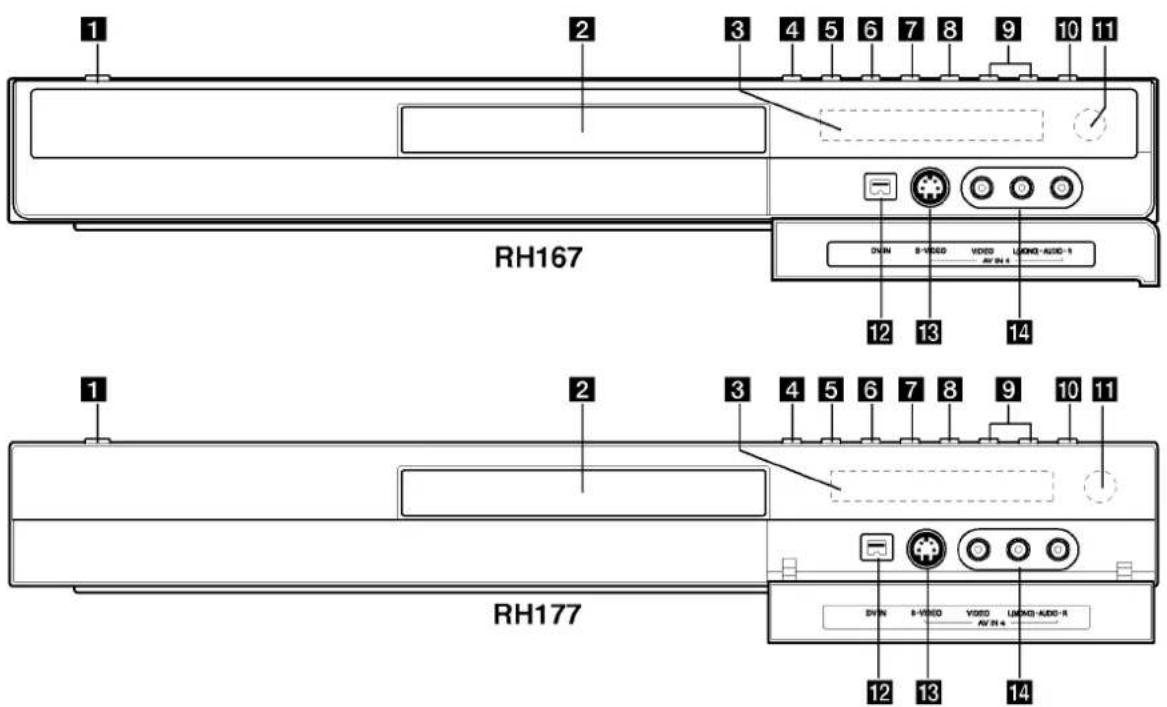
text_image
1 2 3 4 5 6 7 8 9 10 11 RH167 DUN 8-VI/EO VIDEO LUNIO-AUDO-5 AV IN 4 12 13 14 1 2 3 4 5 6 7 8 9 10 11 RH177 DVIN 8-VI/EO VIDEO LUNIO-AUDO-R AV IN 4 12 13 141 POWER button
Switches the recorder ON or OFF.
2 Disc Tray
Insert a disc here.
3 Display window
Shows the current status of the recorder.
T/S: Indicates the timeshifting mode.
REC: The recorder is recording.
HDD: The recorder is HDD mode.
DVD: The recorder is DVD mode.
HDD ◀▶ DVD: The recorder is dubbing.
TV: Indicates when the recorder is in TV tuner mode.
⑨ : Indicates when the recorder is in timer recording or a timer recording is programmed.
Indicates clock, total playing time, elapsed time, title number, chapter/track number, channel, etc.
4 OPEN/CLOSE (▲)
Opens or closes the disc tray.
5 HDD/DVD
Set the recorder's mode to HDD or DVD.
6 ■ (STOP)
Stops playback or recording.
7 ▶ / II (PLAY / PAUSE)
Starts playback.
Pause playback or recording temporarily, press again to exit pause mode.
8 ● (REC)
Starts recording. Press repeatedly to set the recording time.
9 PROG. (▼/▲)
Scans up or down through memorized channels.
10 TIMESHIFT
Activates pause live TV/playback (timeshift) for a live TV program.
11 Remote Sensor
Point the recorder remote control here.
12 DV IN
Connect the DV output of a digital camcorder.
13 AV IN 4 (S-VIDEO IN)
Connect the S-Video output of an external source (TV/ Monitor, VCR, Camcorder, etc.).
14 AV IN 4 (VIDEO IN/AUDIO IN (Left/Right))
Connect the audio/video output of an external source (Audio system, TV/ Monitor, VCR, Camcorder, etc.).
Remote Control

text_image
POWER OPEN/ CLOSE DVD HDD AVINPUT AVINPUT 1 2 3 4 5 6 7 8 9 DUBBING MUTE AUDIO SUBTITLE CLEAR ● REC REO MODE TIMER REC SCAN SKIP PAUSE/STEP PLAY STOP HOME PVCH MENULIST ENTER DISPLAY RETURN TIMESH MARKER - SEARCH SETUP PP ZOOM TITLE CHP ADD LSKIP REPEAT A-S TRIMINAL TV/DVD1
2
3
4
5
POWER: Switches the recorder ON or OFF.
OPEN/CLOSE (▲): Opens and closes the disc tray.
DVD: Selects the unit's function mode to DVD.
HDD: Selects the unit's function mode to HDD.
AV/INPUT: Changes the input to use for recording (Tuner, AV1-4, or DV IN).
0-9 numerical buttons: Selects numbered options in a menu.
DUBBING: Copies DVD to HDD (or HDD to DVD).
TV Control Buttons: See page 54.
2
AUDIO (○): Selects an audio language or audio channel.
SUBTITLE (☐): Selects a subtitle language.
CLEAR: Removes a track number on the Program List or a mark on the Marker Search menu.
REC (●): Starts recording.
REC MODE: Selects the recording mode.
TIMER REC: Displays Timer Record menu.
3
SCAN (◀◀ / ▶▶): Search backward or forward.
SKIP (I◄◄ / ►►I): Go to next or previous chapter or track.
PAUSE/STEP (II) : Pause playback or recording temporarily.
PLAY (▶): Starts playback.
STOP (■): Stops playback or recording.
4
HOME: Accesses or removes the HOME menu.
MENU/LIST: Accesses menu on a DVD disc. Switches between Title List-Original and Title List-Playlist menu.
◀ / ▶ / ▲ / ▼ (left/right/up/down): Selects an option in the menu.
ENTER (◎)
- Acknowledges menu selection.
- Displays information while viewing a TV program.
PR/CH (+/-): Scans up or down through memorized channels.
DISPLAY: Accesses On-Screen Display.
RETURN (💡)
Removes the menu.
5
TIMESHIFT: Activates pause live TV/playback (timeshift) for a live TV program.
MARKER: Marks any point during playback.
SEARCH: Displays Marker Search menu.
SETUP: Accesses or removes the Setup menu.
PIP: Selects PIP function on or off.
ZOOM: Enlarges video image.
TITLE: Displays the disc's Title menu, if available.
CHP. ADD: Inserts a chapter marker when playing/recording.
I.SKIP (INSTANT SKIP): Skips 15 seconds forward during playback.
REPEAT: Repeat chapter, track, title, all.
A-B: Repeat sequence.
THUMBNAIL: Selects a thumbnail picture.
TV/DVD: To view channels selected by the recorder tuner or by the TV tuner.
Remote Control Operation
Point the Remote Control at the remote sensor and press the buttons.
Caution
Do not mix old and new batteries. Never mix different types of batteries (standard, alkaline, etc.).
Remote Control Battery Installation
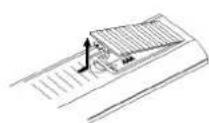
Remove the battery cover on the rear of the Remote Control, and insert two R03 (size AAA) batteries with + and - matched correctly.
Hookup and Settings
Rear Panel
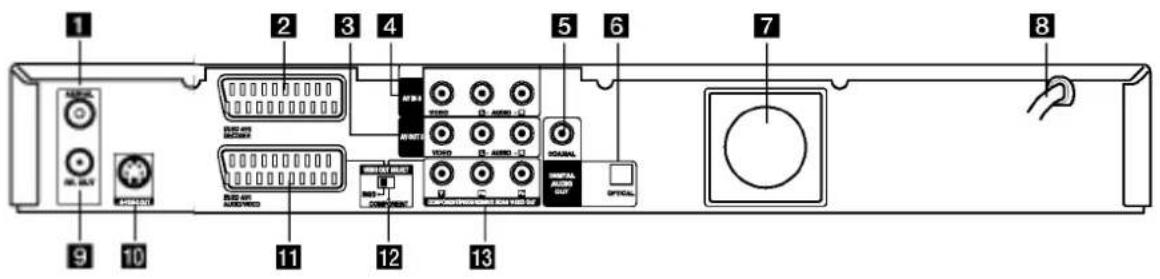
text_image
1 2 3 4 5 6 7 8 9 10 11 12 13 MOSUAL HOLDEN MOSUAL MOSUAL MOSUAL MOSUAL MOSUAL MOSUAL MOSUAL MOSUAL MOSUAL MOSUAL MOSUAL MOSUAL MOSUAL MOSUAL MOSUAL MOSUAL MOSUAL MOSUAL MOSUAL MOSUAL MOSUAL MOSUAL MOSUAL MOSUAL MOSUAL MOSUUM MOSUUM MOSUUM MOSUUM MOSUUM MOSUUM MOSUUM MOSUUM MOSUUM MOSUUM MOSUUM MOSUUM MOSUUM MOSUUM MOSUUM MOSUUM MOSUUM MOSUUM MOSUUM MOSUUM MOSUIM MOSUIM MOSUIM MOSUIM MOSUIM MOSUIM MOSUIM MOSUIM MOSUIM MOSUIM MOSUIM MOSUIM MOSUIM MOSUIM MOSUIM MOSUIM MOSUIM1 AERIAL Connect the aerial to this terminal.
2 EURO AV 2 DECODER
Connect the audio/video output of an external source (Pay-TV decoder, Set Top Box, VCR, etc.).
3 AV OUT 3 (VIDEO / AUDIO OUT (Left/Right))
Connect to a TV with video/audio inputs.
4 AV IN 3 (VIDEO IN/AUDIO IN (Left/Right))
Connect the audio/video output of an external source (Audio system, TV/ Monitor, VCR, Camcorder, etc.).
5 COAXIAL (Digital audio out jack)
Connect to digital (coaxial) audio equipment.
6 OPTICAL (Digital audio out jack)
Connect to digital (optical) audio equipment.
7 Cooling fan
8 AC Power Cord
Plug into the power source.
9 RF. OUT
Passes the signal from the AERIAL to your TV/monitor
10 S-VIDEO OUT
Connect to a S-Video Input on TV.
11 EURO AV 1 AUDIO/VIDEO
Connect to a TV with SCART jack.
12 VIDEO OUT SELECT Switch
Select either COMPONENT or RGB signal of EURO AV1 AUDIO/VIDEO terminal depending on how you connect the recorder to the TV.
13 COMPONENT/PROGRESSIVE SCAN VIDEO OUT (Y Pb Pr)
Connect to a TV with Y Pb Pr inputs.
Connecting to the Aerial
Remove the aerial cable plug from your TV set and insert it into the aerial socket at the back of the recorder. Plug one end of the aerial cable into the TV socket on the recorder and the other end into the aerial input socket on your TV set.
RF coaxial connection
Connect the RF. OUT jack on the recorder to the aerial input jack on the TV using the 75-ohm Coaxial Cable supplied (R). The RF. OUT jack passes the signal through from the AERIAL jack.

text_image
Aerial Rear of TV ANTERNAL INPUT SCART INPUT AUDIO INPUT VIDEO INPUT AERIAL C RF. OUT LVIDENCE EURO AND DECKER EURO AND AUDIO/VIRIO AV IN 3 VIDEO AV OUT 1 VIDEO WORD OUT SELECT RGB COMPONENT COMPARATIONRear of the recorder
Connections to Your TV
- Make one of the following connections, depending on the capabilities of your existing equipment.
- When using the COMPONENT/PROGRESSIVE SCAN VIDEO OUT jacks, set the VIDEO OUT SELECT switch to COMPONENT. When using the SCART jack, set the VIDEO OUT SELECT switch to RGB.
Tips
- Depending on your TV and other equipment you wish to connect, there are various ways you could connect the recorder. Use only one of the connections described below.
- Please refer to the manuals of your TV, VCR, Stereo System or other devices as necessary to make the best connections.
Caution
- Make sure the recorder is connected directly to the TV. Tune the TV to the correct video input channel.
- Do not connect the recorder's AUDIO OUT jack to the phono in jack (record deck) of your audio system.
- Do not connect your recorder via your VCR. The DVD image could be distorted by the copy protection system.
Rear of TV

text_image
Rear of the recorder S T C V A RECAST INPUT COMPONENT VIDEO INPUT VIDEO INPUT AUDIO INPUT AV OUT1 AV OUT2 AV VOUT AV VOUT3 AV VOUT4 AV VOUT5 AV VOUT6 AV VOUT7 AV VOUT8 AV VOUT9 AV VOUT10 AV VOUT11 AV VOUT12 AV VOUT13 AV VOUT14 AV VOUT15 AV VOUT16 AV VOUT17 AV VOUT18 AV VOUT19 AV VOUT20 AV VOUT21 AV VOUT22 AV VOUT23 AV VOUT24 AV VOUT25 AV VOUT26 AV VOUT27 AV VOUT28 AV VOUT29 AV VOUT30 AV VOUT31 AV VOUT32 AV VOUT33 AV VOUT34 AV VOUT35 AV VOUT36 AV VOUT37 AV VOUT38 AV VOUT39 AV VOUT40 AV VOUT41 AV VOUT42 AV VOUT43 AV VOUT44 AV VOUT45 AV VOUT46 AV VOUT47 AV VOUT48 AV VOUT49 AV VOUT50 AV VOUT51 AV VOUT52 AV VOUT53 AV VOUT54 AV VOUT55 AV VOUT56 AV VOUT57 AV VOUT58 AV VOUT59 AV VOUT60 AV VOUT61 AV VOUT62 AV VOUT63 AV VOUT64 AV VOUT65 AV VOUT66 AV VOUT67 AV VOUT68 AV VOUT69 AV VOUT70 AV VOUT71 AV VOUT72 AV VOUT73 AV VOUT74 AV VOUT75 AV VOUT76 AV VOUT77 AV VOUT78 AV VOUT79 AV VOUT80 AV VOUT81 AV VOUT82 AV VOUT83 AV VOUT84 AV VOUT85 AV VOUT86 AV VOUT87 AV VOUT88 AV VOUT89 AV VOUT90 AV VOUT91 AV VOUT92 AV VOUT93 AV VOUT94 AV VOUT95 AV VOUT96 AV VOUT97 AV VOUT98 AV VOUT99 AV VOUT100SCART connection
Connect the EURO AV1 AUDIO/VIDEO scart jack on the recorder to the corresponding in jacks on the TV using the scart cable (T).
Video connection
Connect the VIDEO OUT jack on the recorder to the video in jack on the TV using the video cable (V).
Audio (Left/Right) Connection
Connect the left and right AUDIO OUT jacks of the recorder to the audio left and right IN jacks on the TV using the audio cables (A). Do not connect the recorder's AUDIO OUT jack to the phono in jack (record deck) of your audio system.
S-Video connection
Connect the S-VIDEO OUT jack on the recorder to the S-Video in jack on the TV using the S-Video cable (S).
Component Video connection
Connect the COMPONENT / PROGRESSIVE SCAN VIDEO OUT jacks on the recorder to the corresponding input jacks on the TV using an Y Pb Pr cable (C).
If your television is a high-definition or "digital ready" television, you may take advantage of the recorder's progressive scan output for the highest video resolution possible. If your TV does not accept the Progressive Scan format, the picture will appear scrambled if you try Progressive Scan on the recorder.
- Set the [Progressive Scan] option to [ON] on the setup menu for progressive signal, see page 17.
Note:
Progressive scan does not work with the analog video connections (yellow VIDEO OUT jack) or S-VIDEO connection.
Caution
Once the setting for Progressive Scan output is entered, an image will only be visible on a Progressive Scan compatible TV or monitor. If you set Progressive Scan to [ON] in error, you must reset the recorder. First, remove the disc in the recorder. Next, press STOP (■) and hold it for five seconds before releasing it. The video output will be restored to the standard setting, and a picture will once again be visible on a conventional analog TV or monitor.
Connecting to an Amplifier
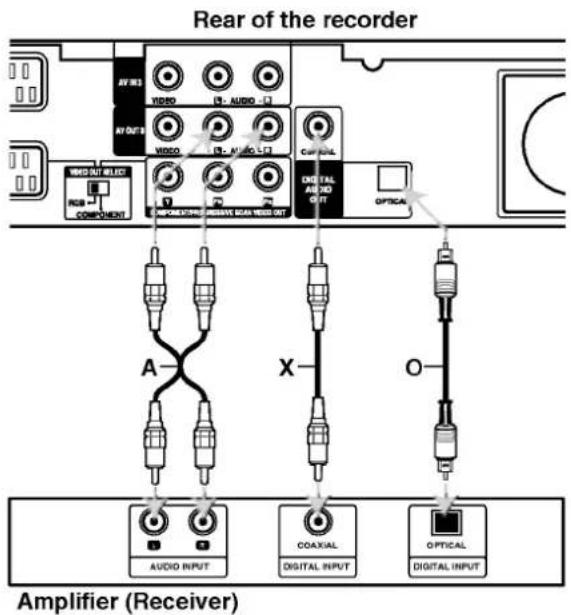
Connecting to an amplifier equipped with two channel analog stereo or Dolby Pro Logic II/Pro Logic
Connect the Left and Right AUDIO OUT jacks on the recorder to the audio left and right in jacks on your amplifier, receiver, or stereo system, using the audio cables (A).
Connecting to an amplifier equipped with two channel digital stereo (PCM) or to an Audio/Video receiver equipped with a multi-channel decoder (Dolby Digital™, MPEG 2, or DTS)
- Connect one of the recorder's DIGITAL AUDIO OUT jacks (OPTICAL O or COAXIAL X) to the corresponding in jack on your amplifier. Use an optional digital (optical O or coaxial X) audio cable.
- You will need to activate the recorder's digital output. (See "Audio Settings" on page 18).
Digital Multi-channel sound
A digital multi-channel connection provides the best sound quality. For this you need a multi-channel Audio/Video receiver that supports one or more of the audio formats supported by your recorder (MPEG 2, Dolby Digital and DTS). Check the receiver manual and the logos on the front of the receiver.
Caution:
Due to the DTS Licensing agreement, the digital output will be in DTS digital out when DTS audio stream is selected.
Notes:
- If the audio format of the digital output does not match the capabilities of your receiver, the receiver will produce a strong, distorted sound or no sound at all.
– Six Channel Digital Surround Sound via digital connection can only be obtained if your receiver is equipped with a Digital Multi-channel decoder. - To see the audio format of the current DVD in the on-screen display, press AUDIO.
- This recorder does not perform internal (2 channel) decoding of a DTS sound track. To enjoy DTS multi channel surround, you must connect this recorder to a DTS compatible receiver via one of this recorder's digital audio outputs.
text_image
Rear of the recorder AV M3 VIDEO AUDIO AV DFTB VIDEO AUDIO CAP RAIL DIGITAL AVOID OPTICAL RGB COMPONENT A X O Amplifier (Receiver) AUDIO INPUT COAXIAL DIGITAL INPUT OPTICAL DIGITAL INPUTManufactured under license from Dolby Laboratories. "Dolby", "Pro Logic", and the double-D symbol are trademarks of Dolby Laboratories.
"DTS" and "DTS Digital Out" are trademarks of Digital Theater Systems, Inc.
Accessory Audio/Video (A/V) Connections
Connecting a PAY-TV/Canal Plus Decoder
You can watch or record PAY-TV/Canal Plus programmes if you connect a decoder (not supplied) to the recorder. Disconnect the recorder's mains lead from the mains when connecting the decoder.
To watch or record PAY-TV/Canal Plus programmes, set [AV2 Connection] option to [Decoder] (see page 17) and set the program's [Decoder On/Off] option to [On] on the Setup menu (page 16).
Tip:
You do not need to turn on the recorder to view the signals from the connected tuner on your TV.
Note:
If you disconnect the recorder's mains lead, you will not be able to view the signals from the connected decoder.

text_image
TV PAY-TV/Canal Plus Decoder SCART AV AEBALL RF. OUT SHRDCUT SUNO AVI AUDIO VIDEO AVOUT1 WORD AVOUT1 WORD COMPONENT REDADED/ORDERER Rear of the recorderConnecting to the EURO AV2 DECODER jack
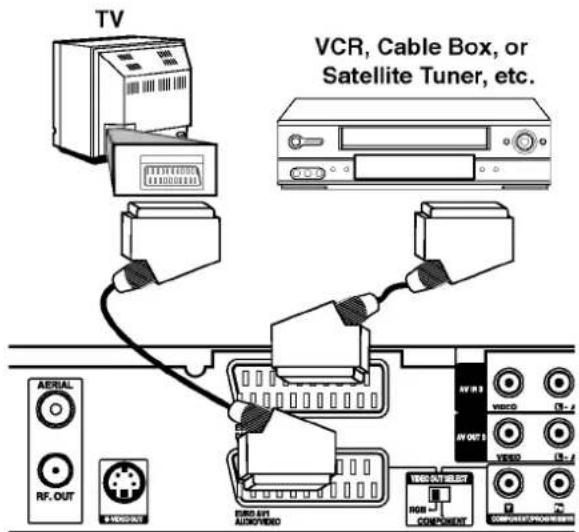
Connect a VCR or similar recording device to the EURO AV2 DECODER jack of this recorder.
To watch or record the source from EURO AV2 DECODER jack, set [AV2 Connection] option to [Others] (see page 17) and set [AV2 Record] option to [Auto], [CVBS] or [RGB] as required (see page 20).
text_image
TV VCR, Cable Box, or Satellite Tuner, etc. AERIAL RF. OUT AUDIO/AVOC AVR 3 VERCO AV OUT 1 VERCO USB OUT 2 COMPONENT COMPUTER/PROFESSIONALRear of the recorder
Tip:
You do not need to turn on the recorder to view the signals from the connected tuner on your TV.
Notes:
- Pictures containing copy protection signals that prohibit any copying cannot be recorded.
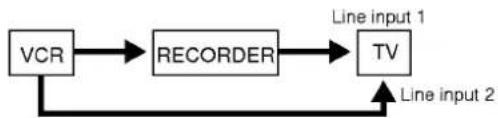
- If you pass the recorder signals via the VCR, you may not receive a clear image on your TV screen. Be sure to connect your VCR to the recorder and your TV in the order shown below. To watch video tapes, watch the tapes through a second line input on your TV.
flowchart
graph LR
    A["VCR"] --> B["RECORDER"]
    B --> C["TV"]
    C --> D["Line input 2"]
    D --> A
- When you record to a VCR from this recorder, do not switch the input source to TV by pressing the TV/DVD button on the remote.
- If you are using a B Sky B tuner, be sure to connect the tuner's VCR SCART jack to the EURO AV2 DECODER jack.
- If you disconnect the recorder's mains lead, you will not be able to view the signals from the connected VCR or tuner.
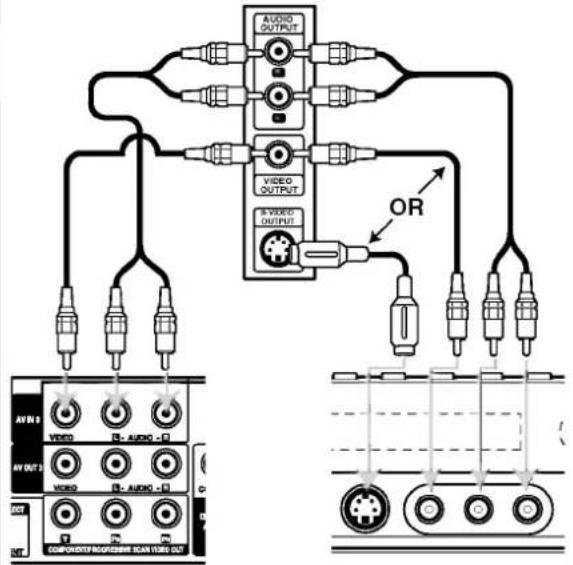
Connecting to the AV IN 3 or AV IN 4 Jacks
Connect the input jacks (AV IN 3, AV IN 4) on the recorder to the audio/video out jacks on your accessory component, using audio/video cables.
Note:
If you use the S-VIDEO IN jack on the front panel, the VIDEO IN jack on the front panel is not available.
Jack panel of Accessory Component (VCR, Camcorder, etc.)
text_image
AUDIO OUTPUT VIDEO OUTPUT 8 VIDEO OUTPUT OR AVEN 3 VIDEO AV OUT 3 VIDEO COMP OUTEXTROPTEXTIC SCAN VIDEO OUTRear of the recorder
Front of the recorder
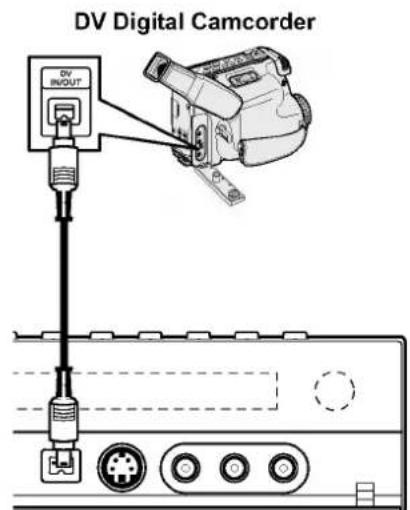
Connecting a Digital Camcorder
Using the front panel DV IN jack, it is possible to connect a DV digital camcorder and digitally transfer DV tapes to DVD.
Use a DV cable (not supplied) to connect the DV in/out jack of your DV camcorder to the front panel DV IN jack of this recorder.
Note:
This jack is for connection to DV digital camcorder only. It is not compatible with digital satellite tuners or D-VHS video decks.
text_image
DV Digital Camcorder DV IN/OUTFront of the recorder
Using the Home Menu
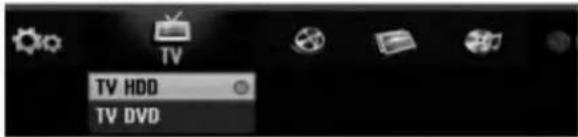
From the Home Menu screen you can access all the Media for playback and recording of the recorder.
- Press HOME to display the Home Menu screen.
- Use the ◀/▶ buttons to select a main option you want. Sub options appears.
- Use the ▲ / ▼ and ENTER buttons to select the sub option you want.
text_image
TV TV HDD TV DVD- To exit the HOME menu, press HOME.
TV
• TV HDD: Returns to live TV viewing for HDD recording.
• TV DVD: Returns to live TV viewing for DVD recording.
MOVIE
• HDD: Displays the Title List menu for HDD. (page 41)
- HDD DivX: Displays the [Movie List] menu for HDD. (page 27)
• DISC:
- Displays Title List menu for recordable disc (page 41)
- Displays [Movie List] menu for DivX disc. (page 27)
- Plays back Video CD or DVD-Video disc (page 23-26).
PHOTO (See page 30)
• HDD: Displays [Photo List] menu for HDD.
• DISC: Displays [Photo List] menu for disc.
MUSIC (See page 28)
• HDD: Displays [Music List] menu for HDD.
• DISC: Displays [Music List] (or Audio CD) menu for disc.
SETUP (See page 15)
- Start: Displays Setup menu.
Initial Settings
In this menu system, there are several ways to customize the settings provided. Most menus consist of three levels to set up the options, but some require greater depth for the variety of settings.
General Operation
- Press SETUP and the Setup menu appears.
- Use ▲ / ▼ to select the desired option.
- While the desired item is selected, press ▶ to move to the second level.
- Use ▲ / ▼ to select the second desired option.
- Press ▶ to move to the third level.
- Use ▲ / ▼ to select the desired setting then press ENTER to confirm your selection. Some items require additional steps.
- Press SETUP to exit the Setup menu.
Note:
Press ◀ to go back to the previous level.
General Settings
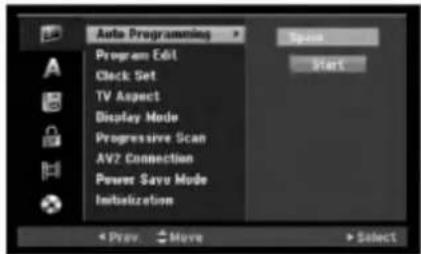
Auto Programming
This recorder is equipped with a frequency synthesized tuner capable of receiving up to 88 TV channels.
Preparation:
- Connect the recorder to the desired type of aerial as shown in Connecting to the Aerial on page 10.
text_image
Auto Programming Program Edit Clock Set TV Aspect Display Mode Progressive Scan AV2 Connection Power Save Mode Initialization Start Pray Move Select- Select the [Auto Programming] option.
- Press ▶ to move to the third level. [Country] option is highlighted.
- Use ▲ / ▼ to select a country then press ▶. [Start] icon is highlighted. If your country is not listed, select [Others]
- Press ENTER to begin the channel search. The tuner will automatically cycle through all available channels in the area and place them in the tuner's memory.
Note:
After you have connected your recorder for the very first time. If you press SETUP for initial setting, you can only set the [Auto Programming] option. Then you can set the other options.
General Settings (Continued)
Program Edit
You can edit a channel manually (add, delete, name, move, etc.).
- Select [Program Edit] option then press ▶
- Press ENTER while [Edit] is selected. The Program List menu appears.

text_image
PR-01 NICAM Program Edit Station Rename Move Delete Decoder 0x001 NICAM Auto01 PR Ch. WFT Station 01 C 1 • 49 ARD 02 C 2 B ARD 03 C 9 B NBC1 04 C 11 B NBC1 05 C 19 • 49 ARD 06 C 48 0 07 C 6 0 08 C 7 • 49 09 C 21 0 10 C 25 0 11 C 43 0- Use ▲ / ▼ to select a PR number then press ENTER.
-
Use ▲ / ▼ to select the program option then press ENTER.
-
[Program Edit] Sets the channel manually. See "Program Edit" on the right.
- [Station Rename] Changes the station name. The display for entering characters appears. To enter characters, see page 45. Names can be up to 5 characters long.
- [Move] Sorts the programme positions on the Program List. Press ▲ / ▼ to move the selected programme position to a new location.
- [Delete] Disables a programme position you do not need.
- [Decoder On/Off] Sets the channels for the decoder. You need this setting to watch or record PAY-TV/Canal Plus programmes. Press ENTER so [Decoder] appears on the display. Press ENTER again to turn off the setting.
-
[NICAM Auto/off] Sets the channels for the NICAM broadcast. Normally, [NICAM] is lit on the display. If the sound from NICAM broadcast is not clear, press ENTER so [NICAM] disappears.
-
Press RETURN (♂) repeatedly to exit Program List menu.
Program Edit
You can perform a search to select and store TV channels manually.
When you select [Program Edit] in step 4 above, the display for setting channels appears.
- Use ◀ / ▶ to select the item and press ▲ / ▼ to change the setting.
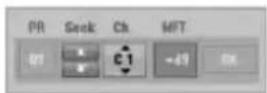
• [PR] indicates the selected programme position.
- [Seek] Searches for a channel automatically. Searching stops when the recorder tunes in a channel.
• [Ch.] Changes the channel number.
- [MFT] Fine tunes the channel to obtain a clearer picture.
- Choose OK then press ENTER to confirm the setting and returns to the Program List menu.
AV1 Decoder
Sets the EURO AV1 AUDIO/VIDEO jack for inputting encoded video signals.
- Press AV/INPUT while the Program List menu appears.
-
Press ENTER so [Canal+] appears on the display. Press ENTER again to turn off the setting.
-
Off: Inputs the signals from the EURO AV1 AUDIO/VIDEO jack. Normally select this.
- On: The encoded video signal input from the EURO AV1 AUDIO/VIDEO jack is output to the EURO AV2 DECODER jack for decoding. The decoded signal is then input back through the EURO AV2 DECODER jack so you can record or view PAY-TV/Canal Plus programmes
General Settings (Continued)
Auto Clock Set
When Channel auto search is completed the actual Time and Date are also set automatically. If the time in the recorder display is not correct, the clock must be set manually.
-
Select [Clock set] option then press ▶.
-
Use ▲ / ▼ to select [Auto] option then press ENTER.
Note:
There are cases where the TV station does not send, or sends wrong date and/or time information and the recorder sets the incorrect time. If this happens, we recommend that you set the clock manually.
Manual Clock Set
-
Select [Clock set] option then press ▶.
-
Use ▲ / ▼ to select [Manual] option then press ENTER.
-
Enter the necessary information for date and time. ◀/▶ (left/right): Moves the cursor to the previous or next column. ▲/▼ (up/down): Changes the setting at the current cursor position.
-
Press ENTER to confirm your setting.
TV Aspect
Selects the aspect ratio of the connected TV (4:3 standard or wide).
• [4:3] Select this when connecting to a 4:3 screen TV. When you select [4:3], set [Display Mode] below.
• [16:9] Select this when connecting to a wide-screen TV or TV with a wide mode function.
Display Mode
Selects how to display a wide picture on the screen when [4:3] is selected in [TV Aspect].
- [Letter Box] Displays a wide picture with bands on the upper and lower portions of the screen.
- [Pan Scan] Automatically displays a wide picture on the entire screen and cuts off the portions that do not fit.
Progressive Scan
Progressive Scan Video provides the highest quality pictures with less flickering.
If you are using the COMPONENT/PROGRESSIVE SCAN VIDEO OUT jacks, but are connecting the recorder to a standard (analog) television, set Progressive Scan to [OFF].
If you are using the COMPONENT/PROGRESSIVE SCAN VIDEO OUT jacks for connection to a TV or monitor that is compatible with a progressive scan signal, set Progressive Scan to [ON].
Note:
Progressive Scan will be disable in the setup menu when the VIDEO OUT SELECT switch on the rear panel is set to RGB position.
Caution
Once the setting for Progressive Scan output is entered, an image will only be visible on a Progressive Scan compatible TV or monitor. If you set Progressive Scan to [ON] in error, you must reset the recorder. First, remove the disc in the recorder. Next, press STOP (■) and hold it for five seconds before releasing it. The video output will be restored to the standard setting, and a picture will once again be visible on a conventional analog TV or monitor.
AV2 Connection
You can connect a decoder or other device to the EURO AV2 DECODER socket on the back.
- [Decoder] Select [Decoder] if you connect the recorder's EURO AV2 DECODER jack to a PAY-TV or Canal Plus decoder.
- [Others] Select [Others] if you connect the recorder's EURO AV2 DECODER jack to a VCR or similar recording device.
Power Save Mode
You can set up the unit into an economic power save mode. Nothing is displayed in the display window when the unit is turned off.
• [OFF] Power Save Mode is not active.
• [ON] Power Save Mode is active.
Notes:
- The encoded television signals (CANAL+ or PREMIERE) are not decoded in the Power Save Mode.
- The Power Save Mode is not available in the standby mode for the timer recording and when power off of the unit after receiving the encoded television signals (CANAL+ or PREMIERE).
General Settings (Continued)
Initialization
You can reset the recorder to its original factory settings and initialize the HDD.
- [Factory Set] If you need to, you can reset the recorder to all its factory settings. Some options cannot be reset. (Rating, Password, and Area Code)
-
[HDD format] Initializes the HDD (Hard Disk Drive): everything recorded on the HDD will be erased.
-
Select [Initialize] option then press ▶.
-
Press ▲ / ▼ to select the desired option then press ENTER.
The confirm message will appear.
- Use ◀ / ▶ to select [Yes] or [No] then press ENTER.
Language Settings

text_image
Display Menu English Français Deutsch Italiano Españal Nederlands Portugols Ekkqvuká Svenska + Prev Move SelectDisplay Menu
Select a language for the Setup menu and on-screen display.
Disc Menu/Audio/Subtitle
- [Original]Refers to the original language in which the disc was recorded.
- [Other] To select another language, press number buttons then ENTER to enter the corresponding 4-digit number according to the language code list in the reference chapter (see page 53). If you enter the wrong language code, press CLEAR.
• Off : Turn off Subtitle.
Audio Settings
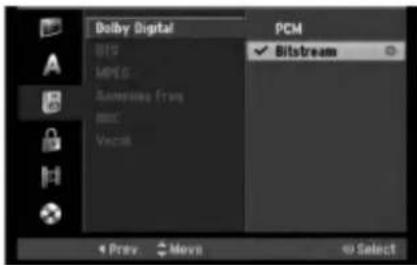
Each DVD disc has a variety of audio output options. Set the recorder's Audio Output according to the type of audio system you use.
text_image
Bolby Digital PCM BITS Bitstream Amplicon From VaccR Prev Move SelectDolby Digital / DTS / MPEG
- [Bitstream]: Select "Bitstream" if you connect the recorder's DIGITAL AUDIO OUT jack to an amplifier or other equipment with a Dolby Digital, DTS or MPEG decoder.
- [PCM] (for Dolby Digital / MPEG): Select when connected to a two-channel digital stereo amplifier. DVDs encoded in Dolby Digital or MPEG will be automatically downmixed to two-channel PCM audio.
- [Off] (for DTS): If you select "Off", the DTS signal is not output through the DIGITAL AUDIO OUT jack.
Sampling Frequency
If your receiver or amplifier is NOT capable of handling 96 kHz signals, select [48 kHz]. When this choice is made, this unit will automatically convert any 96 kHz signals to 48 kHz so your system can decode them.
If your receiver or amplifier is capable of handling 96 kHz signals, select [96 kHz]. When this choice is made, this unit will pass each type of signal through without any further processing.
DRC (Dynamic Range Control)
With the DVD format, you can hear a program's soundtrack in the most accurate and realistic presentation possible, thanks to digital audio technology. However, you may wish to compress the dynamic range of the audio output (the difference between the loudest sounds and the quietest ones). Then, you may listen to a movie at a lower volume without losing clarity of sound. Set DRC to [ON] for this effect.
Vocal
Set Vocal to [ON] only when a multi-channel karaoke DVD is playing. The karaoke channels on the disc will mix into normal stereo sound.
Lock (Parental Control) Settings
text_image
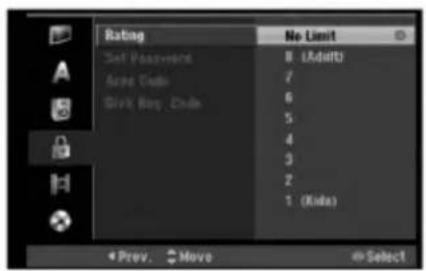
Rating Set Password Active Cache Sink Ring Cache No Limit 8 (Adults) 7 6 5 4 3 2 1 (Kids) Prev. Move SelectRating
Blocks playback of rated DVDs based on their content. Not all discs are rated.
- Select [Rating] option then press ▶.
-
To access the Rating, Password and Area Code features, you must input the 4-digit security code you created.
If you have not yet entered a security code you are prompted to do so. Input a 4-digit code and press ENTER. Enter it again and press ENTER to verify. If you make a mistake before pressing ENTER, press CLEAR. -
Select a rating using the ▲ / ▼ buttons. [1] - [8]: Rating one (1) has the most restrictions and rating eight (8) is the least restrictive.
[No Limit]: If you select [No Limit], parental control is not active and the disc plays in full.
- Press ENTER to confirm your rating selection.
Note:
If you set a rating for the recorder, all disc scenes with the same rating or lower are played. Higher rated scenes are not played unless an alternate scene is available on the disc. The alternative must have the same rating or a lower one. If no suitable alternative is found, playback stops. You must enter the 4-digit password or change the rating level in order to play the disc.
Set Password
- Select [Set Password] option then press ▶.
- Follow step 2 as shown "Rating". To change the password, select the [Change], press ENTER and input the new 4-digit code then press ENTER. Input it again to verify. To delete the password, select [Delete] then press ENTER.
If you forget your 4-digit code
If you forget your password, to clear the current password, follow the procedure below.
- Display Setup menu then select an 1 level icon.
- Use the Number buttons to enter the 6-digit number "210499".
- Select [Yes] then press ENTER. The 4-digit password is cleared. Enter a new code.
Area Code
Enter the code of an area whose standards were used to rate the DVD video disc, referring to the list (See "Area Codes", page 53.).
-
Select [Area Code] option then press ▶.
-
Follow step 2 as shown "Rating".
-
Select the first character using the ▲ / ▼ buttons.
-
Shift the cursor using ▶ buttons and select the second character using ▲ / ▼ buttons.
-
Press ENTER to confirm your area code selection.
DivX Registration Code DivX
We provide you the DivX® VOD (Video On Demand) registration code that allows you to rent and purchase videos using the DivX® VOD service. For more information, visit www.divx.com/vod.
-
Select [DivX Reg. Code] option then press ▶.
-
Press ENTER while [View] is selected and the registration code will appear.
-
Use the registration code to purchase or rent the videos from Divx® VOD service at www.divx.com/vod. Follow the instructions and download the video onto a disc for playback on this unit.
Note:
All the downloaded videos from DivX® VOD can only be played back on this unit.
Recording Settings
text_image
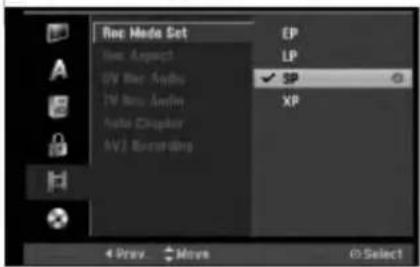
Rec Mode Set New Aspect UV Rev Audio TV Rev Audio Audio Chapter AV Recordings CP LP ✓ SP XP 4 Prev Move © SelectRecord Mode Set
You can set the picture quality for recording; XP (High Quality), SP (Standard Quality), LP (Low Quality), EP (Extend Quality).
Record Aspect
When DVD recording, you can set the recording aspect ratio to suit the material you're recording (16:9 or 4:3).
DV Recording Audio
You need to set this if you have a camcorder using 32kHz/12-bit sound connected to the front panel DV IN jack.
Some digital camcorders have two stereo tracks for audio. One is recorded at the time of shooting; the other is for overdubbing after shooting.
On the Audio 1 setting, the sound that was recorded while shooting is used.
On the Audio 2 setting, the overdubbed sound is used.
TV Recording Audio
When TV recording with bilingual, you can choose audio channel to record.
[Main+Sub] Main language and Sub language [Main] Main language only [Sub] Sub language only
Auto Chapter
When recording in Video mode, chapter markers are put in specified setting. You can change this interval to 5 minutes, 10 minutes or 15 minutes. If you select [None], switch off automatic chapter marking altogether with the [None] setting.
AV2 Recording
You can select the type of the signal when recording video input signal from the device connected to the EURO AV2 DECODER socket.
[Auto] The video input signal will automatically follow the video signal received.
[CVBS] Only for recording CVBS input signal.
[RGB] Only for recording RGB input signal.
Disc Settings
Disc Format
If you load a completely blank disc, the recorder will initialize the disc.
DVD-R: The recorder initialize the disc to Video mode. The recording mode will always be Video mode.
DVD-RW/DVD+RW/DVD+R(DL): The Initialize menu will appears. Select [OK] then press ENTER. DVD-RW disc is initialized to Video mode.
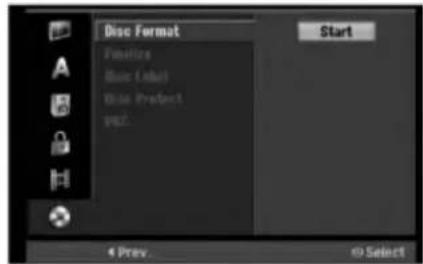
Also, you can reformat the DVD-RW/DVD+RW from the Setup menu as below.
text_image
Disc Format Paste Base Label Base Project Edit Start Prev. Select- Select [Disc Format] option then press ▶.
- Press ENTER while [Start] is selected. Format Disc menu appears.
- Use ◀ / ▶ to select a desired mode (VR Mode or Video Mode) then press ENTER. Confirm message will appear. For DVD+RWs, go to step 4.
- Use ◀ / ▶ to select [OK] then press ENTER. It takes a few moments to initialize the disc.
Caution
If you want to change the disc format, everything recorded on the disc will be erased.
Disc Settings (Continued)
Finalize
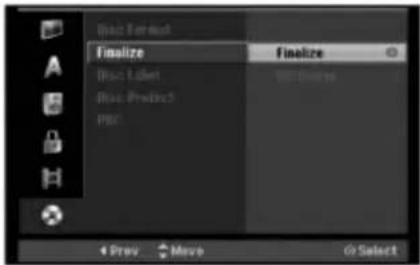
Finalizing 'fixes' the recordings in place so that the disc can be played on a regular DVD player or computer equipped with a suitable DVD-ROM drive. Finalizing a Video mode disc creates a menu screen for navigating the disc. This is accessed by pressing MENU/LIST or TITLE.
Caution
Once you have finalized a DVD-R and DVD+R disc, you cannot edit or record anything else on that disc except DVD+RW. However, you can record and edit a DVD-RW disc by choosing [Unfinalize] option.
text_image
Edit: Edit Finalize Edit: Edit Presets Post Finalize Edit: Presets Post 4 Prev Move Select- Select [Finalize] option then press ▶.
- Press ENTER while [Finalize] is selected. Finalize menu appears.
- Select [OK] then press ENTER. The recorder starts finalizing the disc.
Note:
- How long finalization takes depends on the type of disc, how much is recorded on the disc, and the number of titles on the disc.
- DVD+R DL disc can take up to 30 minutes to finalize.
Tips
- If you load a DVD-RW that has already been finalized, you can 'Unfinalize' it by choosing Unfinalize from the Finalize menu. After doing this, you can edit and re-record onto the disc.
- You cannot unfinalize a DVD-R and DVD+R disc.
- If [Disc Protect] option is set to [ON], the finalize is not available. To finalize, set [Disc Protect] option to [OFF].
Disc Label
Use this to enter a name for the disc. This name appears when you load the disc and when you display disc information on-screen.
- The disc name can be up to 32 characters long.
-
For discs formatted on a different recorder, you will see only a limited character set.
-
Select [Disc Label] option then press ▶.
-
Press ENTER while [Edit] is selected. Keyboard menu appears.
To enter characters, see page 45.
Disc Protect
When recording in DVD+RW / +R disc or VR mode formatted DVD-RW disc, set to [ON] to prevent accidental recording, editing or deleting of the disc loaded. If you need to unlock the disc to make edits, select [OFF].
PBC
PBC stands for Playback Control and refers to special menus and navigation features that are available on some Video CDs.
- [ON] Video CDs are played according to the PBC, if available.
• [OFF] Video CDs are played the same way as Audio CDs.
General Explanation of On-Screen Display
This manual gives basic instructions for operating the recorder. Some DVDs require specific operation or allow only limited operation during playback. When this occurs, the symbol ☑ appears on the TV screen, indicating that the operation is not permitted by the recorder or is not available on the disc.
Displaying Information While Watching TV
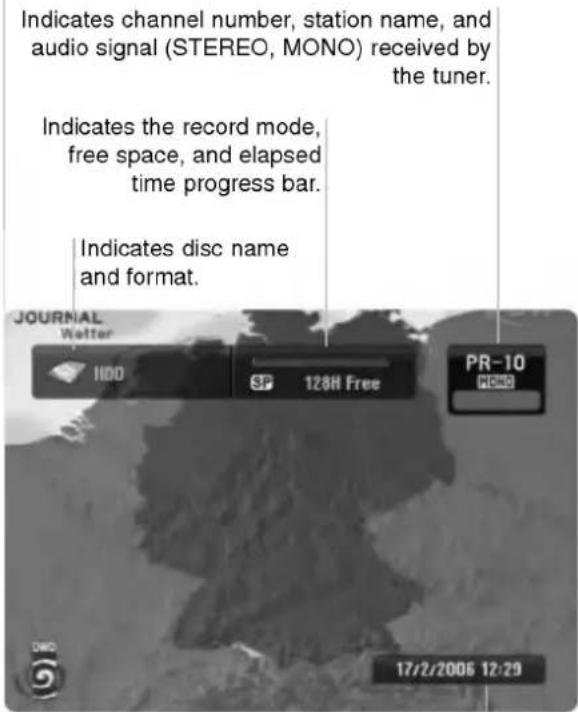
During viewing the TV, press ENTER or DISPLAY to display/remove the information displayed on-screen.
text_image
Indicates channel number, station name, and audio signal (STEREO, MONO) received by the tuner. Indicates the record mode, free space, and elapsed time progress bar. Indicates disc name and format. JOURNAL Wetter HDD SP 128H Free PR-10 MONO 17/2/2006 12:29Indicates current date and time.
Displaying Disc Information on-screen
You can display various information about the disc loaded on-screen.
- Press DISPLAY once to show current status.

text_image
Title : 1/17 Chapter : 1/21 0:00:15 / 2:04:06 DVD-R- Press DISPLAY once again to show various playback information.
The items displayed differ depending on the disc type or playing status.

text_image
DVD-Videm + 1/17* 1/21 0: 00: 15 1. ENG DC/D 5.1CN OFF 1/1 NORMAL Title Move 0-9 Input Enter- You can select an item by pressing ▲ / ▼ and change or select the setting by pressing ◀ / ▶. For details about each item, see the pages in parentheses.
• [Title]: Current title (or track) number/total number of titles (or tracks) (page 23, 25)
• [Chapter]: Current chapter number/total number of chapters (page 23)
• [Time]: Elapsed playing time (page 25)
• [Audio]: Selected audio language (DVD VIDEO only) or audio channel (page 24)
• [Subtitle]: Selected subtitle (page 24)
• [Angle]: Selected angle/total number of angles (page 25)
• [Sound]: Selected sound mode (page 26)
Note:
If no button is pressed for 10 seconds, the on-screen display disappears.
Playback
General Playback Features
- Load your chosen disc in the tray, with the playback side down.
- Starts playback using HOME menu (see page 15).
- To stop the playback, press STOP (■).
The unit records the stopped point, depending on the disc. "■" appears on the screen briefly.
Press PLAY (▶) to resume playback (from the scene point). If you press STOP (■) again or unload the disc ("■" appears on the screen.), the unit will clear the stopped point.
- Press OPEN/CLOSE (▲) to remove the disc.
Press OPEN/CLOSE (▲) to close disc tray or press POWER (○), the disc tray closes automatically and unit turns off.
Note:
If Parental Control is set and the disc is not within the Rating settings (not authorized), the 4-digit code must be entered and/or the disc must be authorized (see "Rating", on page 19).
| Buttons | Operations | Discs |
| OPEN / CLOSE (▲) | Opens or closes the disc tray. | All Discs |
| PAUSE/STEP (II) | During playback, press PAUSE/STEP (II) to pause playback. | All Discs |
| PAUSE/STEP (II) repeatedly to play Frame-by-Frame. | HDD DVD ALL VCD | |
| Tip:You can advance or back up the picture frame-by-frame by pressing ◀ / ▶ repeatedly during PAUSE mode.The picture frame-by-frame in reverse is not available for Video CD. | ||
| SKIP (I◄◄ / ►►I) | During playback, press SKIP (I◄◄ or ►►I) to go to the next chapter/track or to return to the beginning of the current chapter/track.Press SKIP I◄◄ twice briefly to step back to the previous chapter/track.Tips:To go directly to any chapter during DVD playback, press DISPLAY twice and press ▲ / ▼ to select the chapter icon. Then, input the chapter number or use ◀ / ▶.On an Audio CD, to go directly to any track, enter the track number using the numbered buttons (0-9) during playback. | HDD DVD ALL VCDDivX ACD MP3WMA |
| SCAN (◄◄ / ►►) | During playback, press SCAN (◄◄ or ►►) repeatedly to select the required scan speed.HDD, DVD; 5 stepsDivX; 4 stepsVideo CD, Audio CD; 3 steps | HDD DVD ALL VCDDivX ACD |
| While the playback is paused, press SCAN (◄◄ or ►►) repeatedly to play in slow motion.HDD, DVD; 4 stepsVideo CD; 3 steps (Forward only) | HDD DVD ALL VCD | |
| ZOOM | During playback or pause mode, press ZOOM to enlarge the video image.(x1 size → x2 size → x4 size → x1 size (normal size)You can move through the zoomed picture using ◀ ► ▲▼ buttons. | HDD DVD ALL VCD |
General Playback Features (Continued)
| Buttons | Operations | Discs | ||
| REPEAT | During playback, press REPEAT repeatedly to select a desired repeat mode.HDD (Title/Off), DVD (Chapter/Title/Off)VR mode DVD-RW (Chapter/Title/All/Off)Video CD, Audio CD (Track/All/Off)MP3/WMA (Track/Folder/Off)Notes:On a Video CD with PBC, you must set PBC to [OFF] in the Setup menu to use the Repeat function. See page 21.If you press SKIP (▶▶I) once during Repeat Chapter (Track) playback, the repeat playback cancels. | HDDACD | DVD ALLMP3 | VCDWMA |
| A-B | During playback, each press of A-B button to select point A and point B and repeats a sequence from point A (Starting point) to point B (End point).Note:During HDD playback, you cannot select a sequence less than 5 seconds. | HDDACD | DVD ALL | VCD |
| TITLE | If the current DVD title has a menu, the title menu appears on the screen. Otherwise, the disc menu may appears. | DVD | ||
| MENU/LIST | The disc menu appears on the screen. | DVD | ||
| SUBTITLE (☐) | During playback, press SUBTITLE then press ◀ / ▶ repeatedly to select a desired subtitle language. | DVD | ||
| AUDIO (○○) | Press AUDIO then press ◀ / ▶ repeatedly to hear a different audio language or audio track.Note:Some discs feature both Dolby Digital and DTS soundtracks. There is no analog audio output when DTS is selected. To listen to the DTS soundtrack, connect this recorder to a DTS decoder via one of the digital outputs.See page 12 for connection details. | DVD | ||
| Press AUDIO then press ◀ / ▶ repeatedly during playback to hear a different audio channel (STEREO, LEFT or RIGHT).With DVD-RW discs recorded in VR mode and HDD that have both a main and a Bilingual audio channel, you can switch among Main (L), Sub (R), or Main+sub (L+R). | HDD+RWVCD | -RWVR-RDivX | -RWVideo+R | |
| Press AUDIO repeatedly during playback to hear a different audio channel (STEREO, LEFT or RIGHT). | ACD | MP3 | WMA | |
| I.SKIP | Press I.SKIP repeatedly during playback to skip forward 15 seconds.In HDD playback or Timeshift mode, each press ◀ / ▶ skips forward or reverse 5 minutes. | HDD | DVD ALL | |
If a menu screen is displayed DVD VCD
The menu screen may be displayed first after loading a DVD or Video CD which contains a menu.
DVD
Use the ◀ / ▶ / ▲ / ▼ buttons to select the title/chapter you want to view, then press ENTER to start playback.
Press TITLE or MENU/LIST to return to the menu screen.
VCD
- Use the number buttons to select the track you want to view.
Press RETURN (💡) to return to the menu screen. - Menu setting and the exact operating procedures for using the menu may differ depending on the disc. Follow the instructions on the each menu screen. You may also set PBC to [OFF] under Setup menu (see page 21).
Moving to another TITLE HDD -RWVR
-RWVideo +RW -R +R DVD DivX
When a disc has more than one title, you can move to another title as follows:
- Press DISPLAY twice during playback then use ▲ / ▼ to select the title icon. Then, press the appropriate numbered button (0-9) or ◀ / ▶ to select a title number.
Time Search HDD -RWVR -RWVideo +RW
-R +R DVD DivX
To start playing at any chosen time on the disc:
- Press DISPLAY twice during playback. The time search box shows the elapsed playing time.
- Press ▲ / ▼ to select the time clock icon and "0:00:00" appears.
- Input the required start time in hours, minutes, and seconds from left to right. If you enter the wrong numbers, press ◀ / ▶ to move the under bar (_) to the wrong number. Then enter the correct numbers.
- Press ENTER to confirm. Playback starts from the selected time.
Marker Search 6/6

To enter a Marker
You can start playback from up to six memorized points. To enter a marker, press MARKER at the desired point on the disc. The Marker icon appears on the TV screen briefly. Repeat to enter up to six markers.
To Recall or Clear a Marked Scene
- During disc playback, press SEARCH. The marker search menu appears on the screen.
- Use ◀/▶/▲/▼ to select a marked scene that you want to recall or clear.
- Press ENTER and playback starts from the marked scene. Or, press CLEAR and the marked scene is erased from the marker search menu.

text_image
Marker Search Move Select RED Delete CleanCamera Angle DVD
If the disc contains scenes recorded at different camera angles, you can change to a different camera angle during playback.
-
Press DISPLAY during playback. The On-Screen Display appears on the TV screen.
-
Use ▲ / ▼ to select the Angle icon in the On-Screen Display.
-
Use ◀/▶ to select a desired angle. The number of the current angle appears on the TV screen.
Tip:
The ANGLE indicator will blink on the TV screen at scenes recorded at different angles to indicate that angle switching is possible.
3D Surround -RWVR -RWVideo +RW -R
+R DVD VCD DivX
This unit can produce a 3D Surround effect, which simulates multi-channel audio playback from two conventional stereo speakers, instead of the five or more speakers normally required to listen to multi-channel audio from a home theater system.
- Press DISPLAY during playback. The On-Screen Display appears on the TV screen.
- Use ▲ / ▼ to select the Sound icon in the On-Screen Display.
- Use ◀ / ▶ to select "3D SUR". To turn off the 3D Surround effect, select "NORMAL".
Last Condition Memory DVD
This recorder memorizes the user settings for the last disc that you have viewed. Settings remain in memory even if you remove the disc from the recorder or switch off the recorder. If you load a disc that had its settings memorized, the latest stop position is automatically recalled.
Notes:
- Settings are stored in memory for use any time.
- This recorder does not memorize settings of a disc if you switch off the recorder before commencing to play it.
PIP (Picture in Picture) HDD -RWvr
-RWVideo +RW -R +R DVD VCD
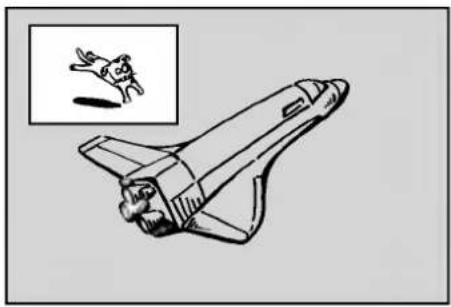
This function enables you to view the stored stations in sub picture during playback.
natural_image
Line drawing of a spacecraft with an inset showing a cartoon character (no text or symbols)On and off
Press PIP to switch on the sub picture, press this button again to switch it off.
Input mode selection for sub picture
Press AV/INPUT to select the input mode for the sub picture. Each time this button is pressed, each input mode for the sub picture is displayed as shown below.
$$ \text { T u n e r } \rightarrow \mathrm{AV} 1 \rightarrow \mathrm{AV} 2 \rightarrow \mathrm{AV} 3 \rightarrow \mathrm{AV} 4 $$
Program selection for sub picture
Use PR/CH (+/-) to change the program when sub picture's input is set to tuner. The selected program number is displayed on the TV screen. You can view the selected program by pressing STOP (■).
Sub picture position change
Press ◀ / ▶ repeatedly until desired position is achieved. The sub picture moves clockwise or counterclockwise.
Zoom Sub picture
Press ZOOM repeatedly to enlarge the sub picture, the magnification level increases up to three steps.
Playing a DivX Movie File
The recorder can play Divx files. Before playing DivX files, read "DivX file requirement" on right.
- Press HOME then select [MOVIE] option.
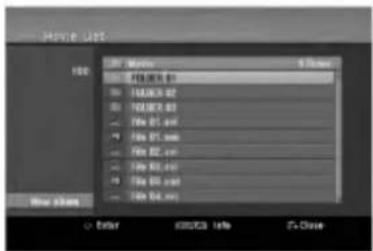
- Select a media that contains DivX file(s) then press ENTER. The [Movie List] menu appears on the TV screen.
text_image
HKEY LIST 100 New items Enter COSCA Info S-Close- Press ▲ / ▼ to select a folder, and press ENTER. A list of files in the folder appears. If you are in a file list and want to return to the Folder list, use the ▲ / ▼ buttons on the remote to highlight 📄. and press ENTER.
- If you want to view a particular file, press ▲ / ▼ to highlight a file and press PLAY (▶). You can use variable playback functions. Refer to pages 23-26.
- Press STOP to stop the playback. The [Movie List] menu appears.
Notice for displaying the DivX subtitle
If the subtitle does not display properly, please follow the steps below.
- Press PAUSE/STEP when the subtitle appears.
- Press and hold SUBTITLE about 3 seconds. The language code will appear.
- Press ◀ / ▶ to select another language code until the subtitle is displayed properly.
- Press PLAY (▶) to continue playback.
Movie List menu options
- Press ▲ / ▼ to select a folder/file on the [Movie List] menu then press ENTER.
[Movie List] menu options appear.
The menu options displayed differ depending on the selected media. - Press ▲ / ▼ / ◀ / ▶ to select an option, and press ENTER.
• [Play] Start playback the selected title. - [Open] Opens the folder and a list of files in the folder appears.
- [Delete] Deletes the file(s) or folder(s) from the media.
• [Rename] Edits the file name.(page 32) - [Move] Moves the file(s) to another folder or media. (page 33)
- [Copy] Copies the file(s) to another folder or media. (page 33)
DivX file requirement
Available resolution size: 720x576 (W x H) pixel
DivX file extensions: ".avi", ".divx"
playable DivX subtitle: ".smi", ".srt",
".sub (Micro DVD format only)",
".txt (Micro DVD format only)"
Playable Codec format: "DIV3", "MP43", "DIVX", "XVID", "DX50"
playable Audio format: "AC3", "PCM", "MP2", "MP3", "WMA"
- Sampling frequency: within 8 - 48 kHz (MP3), within 32 - 48kHz (WMA)
- Bit rate: within 8 - 320kbps (MP3), within 32 - 192kbps (WMA)
CD-R Format: ISO 9660 and JOLIET.
DVD±R/RW Format: ISO 9660 (UDF Bridge format)
Maximum Files/Disc: Less than 1999 (total number of files and folders)
Notes on DivX format
- If the number of the screen frame is over 29.97 frames per second, this unit may not operate normally.
- If the video and audio structure of recorded file is not interleaved, returns to the menu screen.
- If the file is recorded with GMC, the unit supports only 1-point of the record level.
* GMC?
GMC is the acronym for Global Motion Compensation. It is an encoding tool specified in MPEG4 standard. Some MPEG4 encoders, like DivX or Xvid, have this option.
There are different levels of GMC encoding, usually called 1-point, 2-point, or 3-point GMC.
Playing an Audio CD or MP3/WMA file
The recorder can play audio CDs and MP3/WMA files. Before playing MP3/WMA files, read "MP3/WMA audio file requirement" on right.
- Press HOME. The HOME menu appears.
- Select [MUSIC] option.
- Select a media that contains MP3/WMA or audio title then press ENTER. The [Music List] menu appears on the TV screen

text_image
AVOC 10 AVOC 10 AVOC 10 AVOC 1 AVOC 2 AVOC 3 AVOC 4 AVOC 5 AVOC 6 AVOC 7 AVOC 8 AVOC 9 AVOC 10 AVOC 11 AVOC 12 AVOC 13 AVOC 14 AVOC 15 AVOC 16 AVOC 17 AVOC 18 AVOC 19 AVOC 20 AVOC 21 AVOC 22 AVOC 23 AVOC 24 AVOC 25 AVOC 26 AVOC 27 AVOC 28 AVOC 29 AVOC 30 AVOC 31 AVOC 32 AVOC 33 AVOC 34 AVOC 35 AVOC 36 AVOC 37 AVOC 38 AVOC 39 AVOC 40 AVOC 41 AVOC 42 AVOC 43 AVOC 44 AVOC 45 AVOC 46 AVOC 47 AVOC 48 AVOC 49 AVOC 50 AVOC 51 AVOC 52 AVOC 53 AVOC 54 AVOC 55 AVOC 56 AVOC 57 AVOC 58 AVOC 59 AVOC 60 AVOC 61 AVOC 62 AVOC 63 AVOC 64 AVOC 65 AVOC 66 AVOC 67 AVOC 68 AVOC 69 AVOC 70 AVOC 71 AVOC 72 AVOC 73 AVOC 74 AVOC 75 AVOC 76 AVOC 77 AVOC 78 AVOC 79 AVOC 80 AVOC 81 AVOC 82 AVOC 83 AVOC 84 AVOC 85 AVOC 86 AVOC 87 AVOC 88 AVOC 89 AVOC 90 AVOC 91 AVOC 92 AVOC 93 AVOC 94 AVOC 95 AVOC 96 AVOC 97 AVOC 98 AVOC 99 AVOC 100
text_image
100.00 100.00 100.00 100.00 100.00 100.00 100.00 100.00 100.00 100.00 100.00 100.00 100.00 100.00 100.00 125.37 mm 125.37 mm 125.37 mm 125.37 mm 125.37 mm 125.37 mm 125.37 mm 125.37 mm 125.37 mm 125.37 mm 125.37 mm 125.37 mm 125.37 mm 126.37 mm 126.37 mm 126.37 mm 126.37 mm 126.37 mm 126.37 mm 126.37 mm 126.37 mm 126.37 mm 126.37 mm 126.37 mm 126.37 mm 126.37mm 126.37mm 126.37mm 126.37mm 126.37mm 126.37mm 126.37mm 126.37mm 126.37mm 126.37mm 126.37mm 126.37mm 126.37mm 128.37mm 128.37mm 128.37mm 128.37mm 128.37mm 128.37mm 128.37mm 128.37mm 128.37mm 128.37mm 128.37mm 128.37mm 128.37m 128.37m- Use ▲/▼ to select a track then press PLAY (▶). Playback starts.
You can use variable playback functions. Refer to pages 23-26.
Tips:
- Press DISPLAY to view ID3-Tag information for the MP3 file. If ID3-Tag information is not present, [ID3-Tag: None] will appear. If you select a folder, the number of subfolders and number of MP3/WMA files in the folder are displayed. Press DISPLAY again to remove the information screen.
- If you want to move to the upper directory, use the ▲ / ▼ to highlight 🔒 - and press ENTER.
-
You also display HOME menu to select another media by pressing HOME.
-
To stop playback at any time, press STOP.
Tip:
You can create new folder. Select [New Album] option on the Music-HDD menu then press ENTER. "NONAME##" folder is created.
Audio CD and Music menu options
-
Press ▲ / ▼ to select a folder/file on the Audio CD or Music menu then press ENTER.
The menu options appear. The menu options displayed differ depending on the selected media. -
Press ▲ / ▼ / ◀ / ▶ to select an option, and press ENTER.
• [Play] Start playback the selected title.
• [Random] Start or stop random playback.
- [Open] Opens the folder and a list of files in the folder appears
- [Delete] Deletes the file(s) from the media.
• [Rename] Edits the file name. (page 32)
- [Move] Moves the file(s) to another folder or media. (page 33)
- [Copy] Copies the file(s) to another folder or media. (page 33)
- [Program Add] Adds the track(s) to Program List. (page 29)
Random
- Press ▲ / ▼ to select a file then press ENTER. The menu options appear.
- Press ▲ / ▼ to select [Random] option then press ENTER. The unit automatically begins random playback and "RANDOM" appears on the menu screen.
- To return to normal playback, select [Random] option again then press ENTER.
Tip:
By pressing SKIP ▶▶I during Random playback, the unit selects another track and resumes Random playback.
MP3/WMA audio file requirement
File extensions
".mp3", ".wma".
Sampling frequency:
within 8 - 48 kHz (MP3), within 32 - 48kHz (WMA)
Bit rate:
within 8 - 320kbps (MP3), within 32 - 192kbps (WMA)
CD-R Format:
ISO 9660 and JOLIET.
DVD±R/RW Format:
ISO 9660 (UDF Bridge format)
Maximum Files/Disc:
Less than 1999 (total number of files and folders)
Program Playback with Audio CD and MP3/WMA file
Program Playback enables you to make custom playlists of Audio CD or MP3/WMA tracks. Programs can contain up to 99 Audio CD tracks or 256 MP3/WMA files.
- Use ▲ / ▼ to select a track/file (or folder) on the Audio CD or Music menu. You can select all MP3/WMA files and folders on the Music menu by pressing CLEAR button. To cancel the selections, press CLEAR again.
Selecting multiple files/tracks (folders)
- Press MARKER.
A check mark appears on the file/track or folder. Press MARKER again to cancel the marked file/track or folder.
-
Repeat step 1 to mark additional file/track (folders).
-
Press ENTER.
The options appear on the left side of the menu.
-
Use ▲ / ▼ to select the [Program Add] option then press ENTER.
-
Repeat steps 1-3 to mark additional tracks.
Note:
If you select a folder for Programmed Playback, all tracks/files in the folder are added to the Program List.

text_image
Map51.02 File 01.mp3 OK File OK File File File File File File File File File File File File File File File File File File File File File File File File File File File File File File File File File File File File File File File File File File File File File File File File File File C Letter: KSSCA/Mark SReal/Prog, Left F- Dress- Use ▶ to move to the Program list.
The programmed track you selected last is highlighted on the program list.
-
Use ▲ / ▼ to select the track you want to start playing.
-
Press PLAY (▶) to start.
Playback stops after playing the last programmed track in the program list.
- To exit Program Playback and resume normal playback, select a track on the List and press PLAY (▶).
Tip:
You can access or remove the Program List screen by pressing MENU/LIST.
Program List menu options
- Press ▲ / ▼ to select a track/file on the Program List then press ENTER. The menu options appear.

text_image
Map: List File 01.mp3 Program key File 01.mp3 File 02.mp3 File 03.mp3 File 04.mp3 File 05.mp3 File 06.mp3 File 07.mp3 File 08.mp3 File 09.mp3 File 10.mp3 File 11.mp3 File 12.mp3 File 13.mp3 File 14.mp3 File 15.mp3 File 16.mp3 File 17.mp3 File 18.mp3 File 19.mp3 File 20.mp3 File 21.mp3 File 22.mp3 File 23.mp3 File 24.mp3 File 25.mp3 File 26.mp3 File 27.mp3 File 28.mp3 File 29.mp3 File 30.mp3 File 31.mp3 File 32.mp3 File 33.mp3 File 34.mp3 File 35.mp3 File 36.mp3 File 37.mp3 File 38.mp3 File 39.mp3 File 40.mp3 File 41.mp3 File 42.mp3 File 43.mp3 File 44.mp3 File 45.mp3 File 46.mp3 File 47.mp3 File 48.mp3 File 49.mp3 File 50.mp3 File 51.mp3 File 52.mp3 File 53.mp3 File 54.mp3 File 55.mp3 File 56.mp3 File 57.mp3 File 58.mp3 File 59.mp3 File 60.mp3 File 61.mp3 File 62.mp3 File 63.mp3 File 64.mp3 File 65.mp3 File 66.mp3 File 67.mp3 File 68.mp3 File 69.mp3 File 70.mp3 File 71.mp3 File 72.mp3 File 73.mp3 File 74.mp3 File 75.mp3 File 76.mp3 File 77.mp3 File 78.mp3 File 79.mp3 File 80.mp3 File 81.mp3 File 82.mp3 File 83.mp3 File 84.mp3 File 85.mp3 File 86.mp3 File 87.mp3 File 88.mp3 File 89.mp3 File 90.mp3 File 91.mp3 File 92.mp3 File 93.mp3 File 94.mp3 File 95.mp3 File 96.mp3 File 97.mp3 File 98.mp3 File 99.mp3- Use ▲ / ▼ to select an option then press ENTER to confirm your selection.
• [Play] Playback begins in the order in which you programmed the tracks from the selected track.
- [Random] Start or stop random playback.
- [Delete] Deletes the track(s) from the Program List menu.
- [Move] Moves the track(s) to change the program order.
• [Save] Memorizes the program list. (HDD only)
Repeat Programmed Tracks
Press REPEAT to select the desired Repeat mode.
• [TRACK] Repeats the current track.
• [ALL] Repeats all tracks on the Program List.
• [OFF] Cancels Repeat mode (no display).
Erasing a Track from the Program List
-
Select the track you wish to erase from the Program List. Use MARKER button to select multiple tracks.
-
Press ENTER. The menu options appears
-
Select [Delete] option then press ENTER.
Changing Track Order in the Program List
-
Select the track you wish to move on the Program List. Use MARKER button to select multiple tracks.
-
Press ENTER. The menu options appears
-
Select [Move] option then press ENTER.
-
Use ▲ / ▼ to move the yellow bar to the desired location, then press ENTER.
Save Your Program List (HDD only)
This recorder memorizes the user program list that you have programmed.
-
Select a track on the Program List. The menu options appear.
-
Select [Save] option then press ENTER. The Program List is saved in the HDD's PROGRAM folder.
Viewing a JPEG File
The recorder can play JPEG files. Before playing JPEG recordings, read "Photo file requirement" on right.
- Press HOME.
The HOME menu appears.
-
Select [PHOTO] option.
-
Select a media that contains JPEG file then press ENTER.
The [Photo List] menu appears on the TV screen.

text_image
Parts list HES FROSET FROSET 00 FROSET 01 FROSET 02 FROSET 03 FROSET 04 New items Enter GIC3D Mark C-Case- Use ◀ / ▶ / ▲ / ▼ to select a file, then press ENTER.
The menu options appear on the left side of the menu.
Tips:
- If you want to move to the upper directory, use the ▲ / ▼ to highlight 📋 - and press ENTER.
- You can also display HOME menu to select another media by pressing HOME.
- Use ▲ / ▼ to select [Full Screen] then press ENTER.
The selected image is displayed in full screen. Depending upon the size and number of JPEG files, it could take a long time for the recorder to read the files.
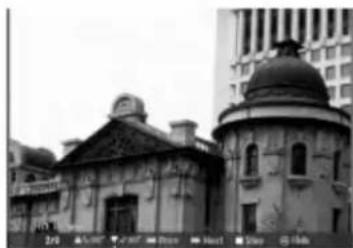
natural_image
Exterior view of a historic building with a dome and arched entrance (no visible text or signage)Press ENTER to appear or disappear this menu during viewing the full screen.
- To stop viewing at any time, press STOP. The [Photo List] menu appears.
[Photo List] menu options
- Press ▲ / ▼ to select a file on the [Photo List] menu then press ENTER.
The menu options appear.
The menu options displayed differ depending on the selected media.
You can select all files and folders on the menu by pressing CLEAR button. To cancel the selections, press CLEAR again.
Selecting multiple files (folders)
- Press MARKER.
A check mark appears on the file or folder. Press MARKER again to cancel the marked file or folder.
-
Repeat step 1 to mark additional file (folders).
-
Use ▲ / ▼ to select an option then press ENTER to confirm your selection.
- [Open] Opens the folder and a list of files in the folder appears
• [Full Screen] Shows the selected file as full screen.
- [Delete] Deletes the selected file from the media.
• [Slide Show] Displays Slide Show menu.
• [Rename] Edits the file name. (page 32)
- [Move] Moves the file(s) to another folder (album) or media. (page 33)
- [Copy] Copies the file(s) to another folder or media. (page 33)
Tip:
You can create new folder in the HDD.
Select [New Album] option then press ENTER.
"NONAME##" folder is created.
Photo file requirement
File extensions
".jpg"
Photo size:
Less than 4MB recommended
CD-R Format:
ISO 9660 and JOLIET.
DVD±R/RW Format:
ISO 9660 (UDF Bridge format)
Maximum Files/Disc:
Less than 1999 (total number of files and folders)
Notes on JPEG file
Progressive and lossless compression JPEG image files are not supported.
Skip Images
While viewing a picture, press SKIP (I◄◄ or ►►I) once to advance to the next file or return to the previous file.
Rotate Images
Use ▲ / ▼ while viewing a picture to flip the picture clockwise or counterclockwise.
View Slide Shows
-
Select [Slide Show] option on the [Photo List] menu (Refer to "Photo List menu options" on page 30).
-
Press ENTER. The Slide Show menu appears.

text_image
Slide Show Object All Speed Normal Simultaneous Music play Start Cancel- Use ◀ / ▶ / ▲ / ▼ to set the options.
[Object] option:
- [Selected] Views slide show only selected files. Use the MARKER button to select multiple files.
• [All] Views slide show all files.
[Speed] option:
Sets the Slide Show speed to [Slow], [Normal], or [Fast].
- Select the [Start] option then press ENTER to start the Slide Show.
- Press STOP to stop the Slide Show and returns to the [Photo List] menu.
To Pause the Slide Show
- Press PAUSE/STEP (Ⅲ) to pause slide show.
- When you want to continue slide show, press PLAY (▶).
To listen to music while slide show simultaneously
You can display photo files while listening to MP3/WMA music files recorded on HDD.
- Select [Slide Show] option on the [Photo List] menu (Refer to "Photo List menu options" on page 30).
- Press ENTER. The Slide Show menu appears.
- Select [Simultaneous Music play] option on the Slide Show menu
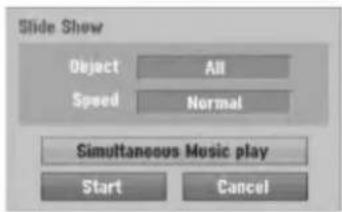
text_image
Slide Show Object All Speed Normal Simultaneous Music play Start Cancel- Press ENTER. Simultaneous Music play menu appears.
-
Press MARKER to select multiple files.
-
Select [Select All] option to select all tracks then press ENTER.
- Select [Deselect All] option to deselect all selected tracks then press ENTER.
-
Select [Cancel] option to exit this menu then press ENTER.
-
Use ◀/▶/▲/▼ to highlight [Start] option then press ENTER.
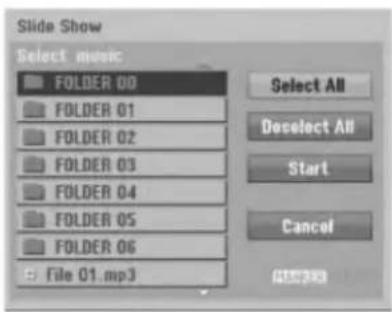
text_image
Slide Show Select music FOLDER 00 FOLDER 01 FOLDER 02 FOLDER 03 FOLDER 04 FOLDER 05 FOLDER 06 File 01.mp3 Select All Deselect All Start Cancel G883888- Press STOP to stop the Slide Show and return to the [Photo List] menu.
Editing a MP3/WMA, JPEG, DivX file
These descriptions are MP3 file's operation for example, other kind's files are operated same way.
Erasing a file(s)/folder(s) from the HDD
You can erase MP3/WMA, JPEG or DivX file(s)/folder(s) on the HDD.
- Select a file you wish to erase on the menu. You can select all files and folders on the menu by pressing CLEAR button. To cancel the selections, press CLEAR again.
Selecting multiple files (folders)
-
Press MARKER. A check mark appears on the file or folder. Press MARKER again to cancel the marked file or folder.
-
Repeat step 1 to mark additional file (folders).
-
Press ENTER. The menu options appear on the menu.

text_image
HDD 100 70 70 70 70 70 70 70 70 70 70 70 70 70 70 70 70 70 70 70 70 70 70 70 70 70 70 70 70 70 70 70 70 70 75 75 75 75 75 75 75 75 75 75 75 75 75 75 75 75 75 75 75 75 75 75 75 75 75 75 75 75 75 75 75 75 75 75- Select [Delete] option then press ENTER. The selected file(s) is deleted.
Naming a file on the HDD
You can name MP3/WMA files on the HDD independently. Names can be up to 32 characters long.
-
Select a file you wish to rename on the menu.
-
Press ENTER. The menu options appear on the menu.
-
Select [Edit] option then press ENTER. Edit options appears.

text_image
File 01.mp3 File 01.mp3 File 01.mp3 File 01.mp3 File 01.mp3 File 01.mp3 File 01.mp3 File 01.mp3 File 01.mp3 File 01.mp3 File 01.mp3 File 01.mp3 File 01.mp3 File 01.mp3 File 01.mp3 File OK OK OK OK OK OK OK OK OK OK OK OK OK OK OK OK OK OK OK OK OK OK OK OK OK OK OK OK OK OK OK OK OK OK OK OK OK OK OK OK OK OK OK OK OK OK OK OK OK OK Ok OK OK OK OK OK OK OK OK OK OK OK OK OK OK OK OK OK OK OK OK OK OK OK OK OK OK OK OK OK OK OK OK OK OK OK OK OK OK- Select [Rename] option then press ENTER. Keyboard menu appears. To enter characters, see page 45.
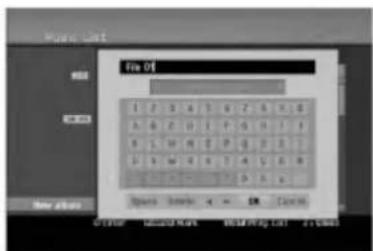
text_image
File Off 1 F 2 S 3 T 4 Z 5 X 6 H 0 B 1 I 2 F 3 G 4 I 5 J B 1 L 2 M 3 P Q R 5 S U 1 S 2 E 3 V 4 W 5 X S 1 S 2 S 3 V 4 W 5 Y New Users Open Subtract OK CancelCopying a file(s) to another media or folder
You can copy a file(s)/folder(s) to another media or folder.
- Select a file you wish to copy on the menu. You can select all files and folders on the menu by pressing CLEAR button. To cancel the selections, press CLEAR again.
Selecting multiple files (folders)
- Press MARKER.
A check mark appears on the file or folder.
Press MARKER again to cancel the marked file or folder.
-
Repeat step 1 to mark additional file (folders).
-
Press ENTER.
The menu options appear on the menu.
-
Select [Edit] option then press ENTER. Edit options appears.
-
Select [Copy] option then press ENTER. Copy menu appears.
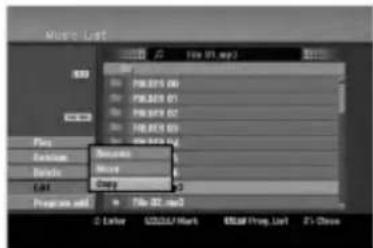
text_image
Music List File 01.mp3 File File1 (0) File2 (0) File3 (0) File4 (0) File5 (0) File6 (0) File7 (0) File8 (0) File9 (0) File10 (0) File11 (0) File12 (0) File13 (0) File14 (0) File15 (0) File16 (0) File17 (0) File18 (0) File19 (0) File20 (0) File21 (0) File22 (0) File23 (0) File24 (0) File25 (0) File26 (0) File27 (0) File28 (0) File29 (0) File30 (0) File31 (0) File32 (0) File33 (0) File34 (0) File35 (0) File36 (0) File37 (0) File38 (0) File39 (0) File40 (0) File41 (0) File42 (0) File43 (0) File44 (0) File45 (0) File46 (0) File47 (0) File48 (0) File49 (0) File50 (0) File51 (0) File52 (0) File53 (0) File54 (0) File55 (0) File56 (0) File57 (0) File58 (0) File59 (0) File60 (0) File61 (0) File62 (0) File63 (0) File64 (0) File65 (0) File66 (0) File67 (0) File68 (0) File69 (0) File70 (0) File71 (0) File72 (0) File73 (0) File74 (0) File75 (0) File76 (0) File77 (0) File78 (0) File79 (0) File80 (0) File81 (0) File82 (0) File83 (0) File84 (0) File85 (0) File86 (0) File87 (0) File88 (0) File89 (0) File90 (0) File91 (0) File92 (0) File93 (0) File94 (0) File95 (0) File96 (0) File97 (0) File98 (0) File99 (0)-
You can select a album (folder) to copy.
-
After selecting a media then press ENTER. The album (folder) list appears.
-
Select a folder. Also, you can create new album (folder). Select [New Album] option on the Copy menu then press ENTER. "NONAME##" folder is created.
-
Select [Copy] option then press ENTER to begin copying.

text_image
Music List Audio Audio content Audio Delete Cancel Add New albums 0 Letter Audio format Match Ping List 61 ChurnNote:
If a folder's depth is more than 5 level, the copy is not available.
Moving a file(s)
You can move a file(s)/folder(s) to another media or folder. After moving, the file(s)/folder(s) are deleted from the current location.
-
Follow steps 1-3 as shown left.
-
Press ENTER.
The options appear on the left side of the menu.
- Select [Move] option then press ENTER. Move menu will appear.
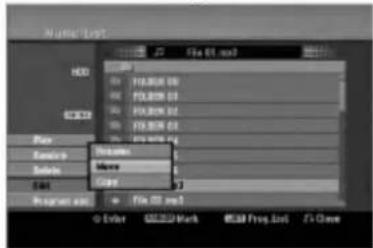
text_image
HDD F1.0000 01 F1.0000 01 F1.0000 01 F1.0000 01 F1.0000 01 F1.0000 01 F1.0000 01 F1.0000 01 F1.0000 01 F1.0000 01 Program.ssd Program.ssd Program.ssd Program.ssd Program.ssd Program.ssd Program.ssd Program.ssd Program.ssd Program.ssd Program.ssd Program.ssd Program.ssd Program.ssd Program.ssd Program.ssd Program.ssd Program.ssd Program.ssd Program.ssd Program.ssd Program.ssd Program.ssd Program.ssd Program.ssd Program.ssd-
You can select a album (folder) to move.
-
After selecting a media then press ENTER. The album (folder) list appears.
-
Select a folder. Also, you can create new album (folder). Select [New Album] option on the Move menu then press ENTER. "NONAME###" folder is created.
-
Select [Move] option then press ENTER to begin moving.
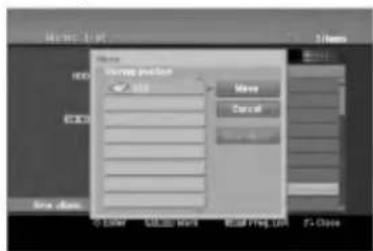
text_image
New Save position Save Cancel New class F1: Linear F2: 0.00 words M3: 0.00 Flag, LPA F3: CloseRecording
About DVD recording
Notes:
- This recorder cannot make recordings on CD-R or CD-RW discs.
- Our company takes no responsibility for recording failure due to power outages, defective discs, or damage to the Recorder.
- Fingerprints and small scratches on a disc can affect playback and/or recording performance. Please take proper care of your discs.
Disc types and recording formats, modes, and settings
This recorder can play five different kinds of DVD discs: pre-recorded DVD-Video discs, DVD-RW, DVD-R, DVD+RW and DVD+R discs. The disc format for DVD-R, DVD+R, DVD+RW discs is always "Video format"—the same as pre-recorded DVD-Video discs. This means that once finalized, you can play a DVD-R, DVD+R, or DVD+RW in a regular DVD player. By default, the DVD-RW disc format is Video format, though you can change this to Video Recording (VR) format, if required. (Reinitializing the disc will erase the contents of the disc.)
The recording mode is closely related to the disc format. If the disc format is Video Recording format, then the recording mode is VR mode; if the disc format is Video mode, then the recording mode is Video mode (except for DVD-Video, which is not recordable, and so does not have a recording mode). Within the recording modes (which are fixed for them whole disc) are the record settings. These can be changed as required for each recording and determine the picture quality and how much space the recording will take up on the disc.
About HDD recording
Recording to the internal hard disk drive (HDD) is basically similar to recording to a VR mode DVD-RW disc. You have the full choice of recording quality options, including the manual mode, and of course you can record, erase and re-record as many times as you like. The capacity of the hard disk drive means that you can store many hours of video on it, even in the higher quality recording modes. To help you organize the contents, the HDD is divided into ten genre. You can name and use these genres as you like—for example, you might have a genre for movies, another for TV shows, and one for camcorder recordings.
Note:
- The maximum number of titles that can be recorded on the HDD is 255.
- Using the HDD allows you to record a maximum of 12 hours continuously.
Notes for recording
- The recording times shown are not exact because the recorder uses variable bit-rate video compression. This means that the exact recording time will depend on the material being recorded.
- When recording a TV broadcast, if the reception is poor or the picture contains interference, the recording times may be shorter.
- If you record still pictures or audio only, the recording time may be longer.
- The displayed times for recording and time remaining may not always add up to exactly the length of the disc.
- The recording time available may decrease if you heavily edit a disc.
- If using a DVD-RW disc, make sure you change the recording format (Video mode or VR mode) before you record anything on the disc. See page 20 (Disc Format) for how to do this.
- When using a DVD-R or DVD+R disc, you can keep recording until the disc is full, or until you finalize the disc. Before you start a recording session, check the amount of recording time left on the disc.
- When using a DVD-RW disc in Video mode, recording time available will only increase if you erase the last title recorded on the disc.
- The Delete Title option in the Title List (Original) menu only hides the title, it does not actually erase the title from the disc and increase the recording time available (except for the last recorded title on a DVD-RW disc in Video mode).
• Overwrite recording is available using DVD+RW discs.
- When using a DVD+R/RW, the recorder will execute the Menu-making operation to update the new title and editing when removing the disc from the recorder or turn off the recorder. So you must remove the disc after selecting the recorder's operation mode to DVD mode.
Recording time and picture quality
There are four preset recording quality modes:
- XP – Highest quality setting, gives about 1 hour of recording time on a DVD (4.7GB).
- SP – Default quality, sufficient for most applications, gives about 2 hours of recording time on a DVD (4.7GB).
- LP – Slightly lower video quality, gives about 4 hour of recording time on a DVD disc (4.7GB).
- EP – Lowest video quality, gives about 6 hour of recording time on a DVD (4.7GB). You may see a fragmented picture during playing back the contents recorded in EP mode.
Timeshift HDD
Do not miss a scene from a live broadcast. If the telephone rings while you are watching your favorite live broadcast, just press "TIMESHIFT" and "PAUSE" before answering the phone. The timeshift function will be activated and the broadcast is then recorded for later viewing.
After the phone call or viewing interruption, press "PLAY" or "SCAN" to watch the program.
Press "STOP" to return to the live broadcast.
Timeshift (Pause, Live TV/Playback) Operation HDD
You can store a program in the HDD storage cache temporarily.
Press TIMESHIFT while watching a TV program.
The Progress Bar display appears on the screen as shown below. The Progress Bar changes to timeshift icon after 5 seconds.
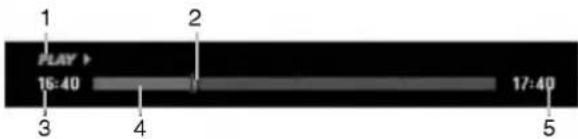
text_image
PLAY 16:40 2 3 4 17:40 5- Indicates playback mode.
- Indicates current Timeshift position.
- Indicates Timeshift start time.
- Indicates Timeshift elapsed time.
- Indicates the time that is one hour from Timeshift start time.
Tips:
- You can use trick play functions (Slow, Scan, etc.) during timeshift. Refer to Playback Operation on pages 23-26.
- You can edit the cached clip during Timeshift to retain the program on the HDD. Refer to Clip Record on the right.
Notes:
- There is not free space on the HDD, the oldest timeshift section of the cache will be incrementally deleted.
- If no button is pressed for 6 hours, the Timeshift will stop automatically.
Marker Search in Timeshift mode
You can mark one in Timeshift mode. Press MARKER at the desired point during Timeshift.
Press SEARCH to recall the marked scene.
Clip Record HDD
You can edit during Timeshift to store the program on the HDD (Hard Disk Drive).
- During Timeshift, use pause step, search and slow-motion to find the starting point.
- Press REC at the starting point of the section you want to record.
Progress of the edit is indicated in red on the Progress Bar.

-
Use pause step, search and slow-motion to find the ending point.
-
Press REC at the ending point of the section you want to record. Normal playback continues.
-
Repeat steps 1 and 4 to make several Clip Records of a program.

-
Press STOP to stop Timeshift. Confirm message will appear.
-
Use ◀ / ▶ to select [Yes] then press ENTER. Or, press STOP again. The current broadcast is displayed on the screen.
Notes:
- Selected sections are recorded on the HDD.
- If you want to stop Clip recording, press the STOP button. If you press POWER to stop Clip recording, the program may not be recorded on the HDD.
- Clip records cannot be made for sections lasting less than 5 seconds.
Jump to Start or End during Timeshift
- Press ENTER during timeshift. The menu will appear.
- Press ◀ and playback starts from the very beginning of the timeshift. Press ▶ and jumps to the very end of the timeshift then goes to pause mode.
To Exit the Timeshift
- Press STOP to exit Timeshift function. Confirm message will appear.
- Use ◀ / ▶ to select [Yes] then press ENTER. The current broadcast is displayed on the screen.
Basic Recording from a TV
Follow the instructions below to record a TV program. Recording starts immediately and continues until the disc is full or you stop the recording.
Note:
You must load a recordable disc for DVD recording.
- Press HOME.
The HOME menu appears. - Select [TV] option.
- Select [TV HDD] or [TV DVD] option then press ENTER.
Also make sure that the TV input is set to this recorder. If you load a completely blank disc, the recorder takes a short while to initialize the disc. - Set a recording mode as necessary by pressing REC MODE repeatedly. (XP, SP, LP, EP)
- Use PR/CH (+/-) buttons to select the TV channel to record.
Changing TV Audio Channel
You can select the audio channel (language) to listen by pressing AUDIO during viewing TV program. The current audio channel is displayed on-screen.
Stereo or mono broadcast:
Stereo → Left → Right → Mono
Bilingual broadcast:
Main → Sub → Main+Sub
- For TV recording with bilingual, set audio channel from the [TV Rec Audio] in sub-menu of the Setup menu (see page 20).
- If the sound is of poor quality when set to Stereo, you can often improve it by changing to Mono (Left or Right).
-
This recorder can record either NICAM or regular audio. If the NICAM setting (page 16) is set to Auto, then if the broadcast is NICAM, the audio automatically changes to NICAM and you can record the NICAM audio. If the broadcast is non-NICAM, the regular audio is always recorded. If NICAM sound distortion occurs, due to poor reception, you can switch off NICAM setting of the program.
-
Press REC (●) once.
Recording will start. (The REC indicator lights in the display window.)
- Recording continues until you press STOP (■) or the disc or HDD is full.
-
To record for a fixed length of time, see Instant Timer Recording on right.
-
Press STOP (■) to stop recording.
To Pause the Recording
- Press PAUSE/STEP (Ⅲ) to pause recording.
- When you want to continue recording, press PAUSE/STEP (III).
To record one TV program while watching another
- Press TV/DVD to select the TV mode during recording. The TV indicator appears.
- Using the TV, select the channel to be viewed.
Instant Timer Recording
Instant Timer Recording allows you to make a recording easily of a preset length without using the program timer.
- Follow steps 1-5 as shown left (Basic Recording from a TV).
- Press REC (●) repeatedly to select the recording time length.
Recording starts after the first press. Each subsequent press increases the recording time within free space (maximum 240 minutes). The recording time is displayed on the TV screen. At the end of the recording, the recorder will stop recording and shut off.
Checking the Recording Time
Press REC (●) once to check the recording time. The recalled setting will automatically return to the TV screen for a moment.
Also, remaining time of recording is shown in the display window.
To Extend the Recording Time
The recording time can be extended anytime by pressing REC (●).
Each subsequent press increases the recording time within free space (maximum 240 minutes).
Caution
If the recorder is unplugged (or there is a power failure) while the recorder is recording, the recording will be lost.
Timer Recording
This recorder can be programmed to record up to 16 programs within a period of 1 month. For unattended recording, the timer needs to know the channels to be recorded, the starting and ending time.
Note:
If you use a completely blank disc for timer recording, you must format the disc before starting timer recording. (Refer to "Disc Format" on page 20.)
1. Press TIMER REC.
The Timer Record menu will appear.
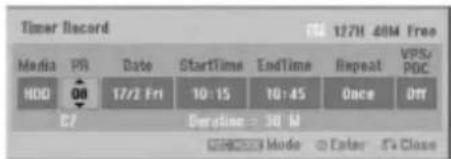
text_image
Timer Record 127H 48M Free Media PRI Date StartTime EndTime Repeat VPS/ HDD Q6 17/2 Fri 10:15 10:45 Once Off C7 Duration: 30 M MODE Enter To Close- [Media] Choose a media to record (HDD or DVD).
- [PR] Choose a memorized program number, or one of the external inputs from which to record. (You cannot select DV input.)
- [Date] Choose a date up to 1 month in advance.
• [Start Time] Set the start time.
• [End Time] Set the end time. - [Repeat] Choose a desired repeat (Once, Daily (Monday - Friday), or Weekly).
- [VPS/PDC] The VPS/PDC system automatically adjusts the recording time so that even if a program is not running to schedule, you won't miss it. For VPS/PDC to work properly, you must input the correct announced time and date of the program you want to record. Note that VPS/PDC may not work with every station.
Notes:
- Stations that use VPS/PDC typically include VPS/PDC information in the teletext TV guide pages. Please refer to these pages when setting a timer recording.
-
When using VPS/PDC, there may be instances where the beginning of the program is not recorded.
-
Enter the necessary information for your timer recording(s).
-
◀ / ▶ (left/right) – move the cursor left/right
- ▲ / ▼ (up/down) – change the setting at the current cursor position
- Press RETURN (♂) to exit the Timer Record menu.
- Press ENTER after filling in all the program information.
-
Press TIMER REC to display Timer Record List.
-
Set a recording mode as necessary by pressing REC MODE repeatedly. (XP, SP, LP, EP)
- Press ENTER, the program will be memorized by the recorder.
To check the programming, the Timer Record List will appear.
Check field's "Rec. OK" on the Timer Record List indicates that the timer recording is programmed correctly.
- Press RETURN (♂) to exit the Timer Record List.
- Make sure that you load a recordable disc for DVD recording and press POWER to switch your unit to Standby.
Notes:
- The timer indicator lights in the display window when the recorder is in standby with the timer active. (Nothing is displayed while the [Power Save Mode] is ON.)
- For TV recording with bilingual, set audio channel from the [TV Rec Audio] in sub-menu of the Setup menu (see page 20).
- You must press STOP to stop the timer recording.
- If you set a timer recording to record to DVD but there isn't a recordable DVD loaded at the time of the recording, the Recovery Recording feature will automatically record the program to the HDD for you.
Checking Timer Recording Details
Programming can be checked whenever the recorder is turned on. Press TIMER REC twice.
- Use ▲ / ▼ to select a timer recording.
- Press ENTER to edit the selected program. Timer Record menu appears.
- Press CLEAR to delete the selected program from the Timer Record List.
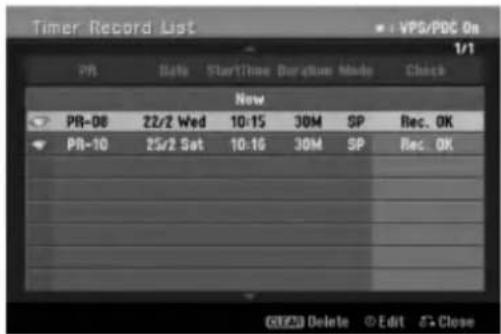
text_image
Timer Record List VPS/POC On 1/1 PR Date StartTime Duration Mode Check New PR-08 22/2 Wed 10:15 30M SP Rec. OK PR-10 25/2 Sat 10:16 30M SP Rec. OK GK23D Delete Edit Stop CloseCanceling a Timer Recording
You can clear a timer setting anytime before the recording actually starts.
- Use ▲ / ▼ to select a program you want to erase on the Timer Recorder List. If you want to erase the program, press CLEAR.
Stopping a Timer Recording in Progress
After a timer recording has started, you can still cancel the program.
- Press STOP.
Timer Recording Troubleshooting
Even though the timer is set, the recorder will not record when:
- There is no disc loaded and there is not free space on the HDD.
- A non-recordable disc is loaded and there is not free space on the HDD.
- [Disc Protect] option is set to [ON] in the Setup menu and there is not free space on the HDD. (see page 21).
• Power is turned on. - There are already 99 titles (DVD-RW, DVD-R), 49 titles (DVD+R, DVD+RW) recorded on the disc and there are already 255 titles recorded on the HDD.
You cannot enter a timer program when:
• A recording is already underway.
- The time you're trying to set has already passed.
• There are already 16 timer programs set.
If two or more timer programs overlap:
• The earlier program takes priority.
- When the earlier program finishes, the later program starts.
- If two programs are set to start at exactly the same time, the program entered first takes priority.
If the disc is damaged, the recording may not complete successfully. In this case even though the Check field shows "Rec. OK", it may not be.
Recording from an External Input
Recording from External Components
You can record from an external component, such as a camcorder or VCR, connected to any of the recorder's external inputs.
- Make sure that the component you want to record from is connected properly to the recorder. See page 13-14.
- Choose a media (TV HDD or TV DVD) to record using HOME menu. (see page 15).
- Press AV/INPUT repeatedly to select the external input to record from.
- Tuner: Built-in tuner
• AV1: EURO AV1 AUDIO VIDEO mounted on back panel
- AV2: EURO A/V2 DECODER mounted on back panel
• AV3: AV IN 3 mounted on back panel
- AV4: AV IN 4 (VIDEO, AUDIO (L/R), S-VIDEO IN) mounted on front panel
• DV: DV IN mounted on front panel
- Select the recording mode as necessary by pressing REC MODE repeatedly. (XP, SP, LP, or EP)
- Press REC (●) once. Recording will start. (The REC indicator lights in the display window.)
- Recording continues until you press STOP (■) or the disc is full.
- To record for a fixed length of time, see "Instant Timer Recording" on page 36.
- Press STOP (■) to stop recording.
Note:
If your source is copy-protected using CopyGuard, you will not be able to record it using this recorder. See Copyright on page 49 for more details.
Recording from DV Input
Before DV dubbing
You can connect a DV-equipped camcorder to this recorder using a single DV cable for input and output of audio, video, data and control signals.
- This recorder is only compatible with DV-format (DVC-SD, DV25) camcorders. Digital satellite tuners and Digital VHS video recorders are not compatible.
- You cannot connect more than one DV camcorder at a time to this recorder.
- You cannot control this recorder from external equipment connected via the DV IN jack (including two recorders).
- It may not always be possible to control the connected camcorder via the DV IN jack.
- Digital camcorders can usually record audio as stereo 16-bit/48kHz, or twin stereo tracks of 12-bit/32kHz. This recorder can only record one stereo audio track. Set [DV Rec Audio] option to [Audio 1] or [Audio 2] as required (see page 20).
- Audio input to the DV IN jack should be 32 or 48kHz (not 44.1kHz).
- Picture disturbance on the recording may occur if the source component pauses playback or plays an unrecorded section of tape, or if the power fails in the source component, or the DV cable becomes disconnected.
Recording from a Digital Camcorder
You can record from a digital camcorder connected to the DV IN jack on the front panel of this recorder.
Using the recorder's remote, you can control both the camcorder and this recorder.
Before recording, make sure that the audio input for the DV IN jack is set up (see page 20).
Tips:
• The source signal must be DVC-SD format.
- Some camcorders cannot be controlled using this recorder's remote.
- If you connect a second recorder using a DV cable, you cannot control the second DVD from this one.
- You cannot control this unit remotely from a component connected to the DV IN jack.
- You cannot record date and time information from a DV cassette.
- Make sure your digital camcorder is connected to the front panel DV IN jack. See page 14.
- Select [TV HDD] or [TV DVD] option on the HOME menu then press ENTER. (see page 15).
- Check that the DV audio input is as you require. You can choose between Audio 1 (original audio) and Audio 2 (overdubbed audio).
- DV Input is set from the [DV Rec Audio] in sub-menu of the Setup menu. See "DV Recording Audio" on page 20 for more information.
- Press AV/INPUT repeatedly to select the DV input. DV appears in the display window and on the TV screen.
- Find the place on the camcorder tape that you want to the recording to start from.
For best results, pause playback at the point from which you want to record.
- Depending on your camcorder, you can use this recorder's remote to control the camcorder using the STOP, PLAY and PAUSE functions.
-
Press REC (●) once to start recording.
-
Recording is automatically stopped if the recorder detects no signal.
- You can pause or stop the recording by pressing PAUSE/STEP (■) or STOP (■). You cannot control the camcorder from this remote control during recording.
- In Video mode, the final frame of the recording may remain displayed on screen for a while after recording stops.
Troubleshooting
If you cannot get a picture and/or audio through the DV IN jack, check the bullet points:
- Make sure the DV cable is properly connected.
- Try switching off the connected equipment then switch back on.
- Try switching the audio input.
Note:
Depending on the connected camcorder, you may not be able to control it using the remote control supplied with this recorder.
Simultaneous recording and playback
Playback another title during recording
Playback and recording for both DVD and built in hard disk drive (HDD) are completely independent. For example, you can record to either the DVD or HDD source and play back video from the other source at the same time.
- Start recording.
- Press HOME to display the Home Menu screen.
- Use the ▲ / ▼ / ◀ / ▶ and ENTER buttons to select a different media type that you want to play back.
- Start Playback. The recording will continue while playing back the media from the other mode.
Notes:
- You can't use simultaneous playback and recording while copying.
- You cannot edit programs during simultaneous recording and playback.
Time Slip HDD
You can play back the current title in recording simultaneously.
- Start HDD recording.
- Press PLAY (▶). The playback starts and the recording will continue while playing back.
- You can use PAUSE (III) and SCAN (◄◄ / ►►) buttons for pause, scan, slow-motion during playback.
- Press STOP (■). The playback will stop then returns to the current recording position.
Notes:
- Playback cannot be started until 15 seconds after recording starts.
- This function does not work in DVD recording mode.
Editing
Title List and Chapter List Menu Overview
Using the Title List menu you can edit video content. The editing features available in the Title List menu depend on whether you are editing video on DVD, or the HDD, and whether you're editing Original content, or a Playlist.
There are two ways to edit VR mode DVD-RW discs. You can directly edit the Original content of the disc, or you can create and edit a Playlist. The Playlist doesn't actually change any of the content on the disc, but just controls how the content is played back.
Editing material recorded on the HDD is similar to editing the Original content of a VR mode DVD-RW, with similar commands for erasing and naming titles, as well as fine control over the content of chapters within titles for DVD disc.
Note:
During recording, if you display the Title List menu for the HDD, some of the titles may appear with a mark. These titles were recorded with a Line Input setting different to the current setting of the recorder. During recording, these titles cannot be played.
-
Press MENU/LIST to display the Title List menu. Playback should be stopped when you do this.
-
You can also access it using HOME menu, select [MOVIE] option then select [HDD] or [DVD] option and press ENTER.
- When selecting titles, use the ▲ / ▼ buttons to display the previous/next page if there are more than six titles.
- If you are editing a VR mode disc, press MENU/LIST to switch between Original and Playlist menu.
On the left side of the screen are the menu options. The main part of the screen shows thumbnails of the titles (or chapter) on the DVD or HDD. You can change these thumbnails using the THUMBNAIL button—see Changing Title Thumbnails on page 42.
Press DISPLAY to display the information of selected title on the Title List menu.
After selecting a title or chapter on the Title List or Chapter List menu, then press ENTER. The menu options appears on the left side of the menu. Use ▲ / ▼ to select a option then press ENTER to confirm your selection.
- To exit the Title List menu, press RETURN (💡) repeatedly.
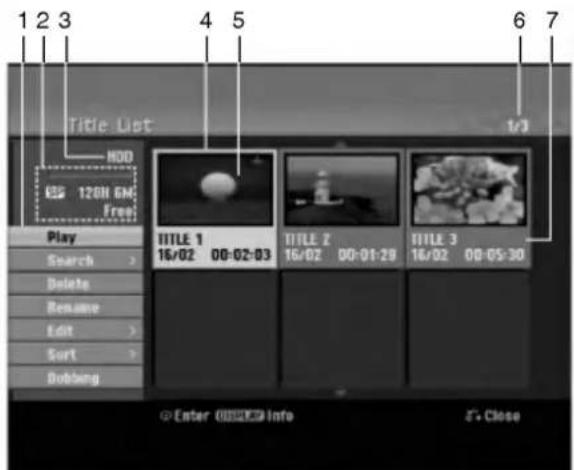
text_image
1 2 3 4 5 6 7 Title List HDD 120H GM Free Play Search > Delete Rename Edit > Sort ? Dubbling TITLE 1 16/02 00-02-03 TITLE 2 16/02 00-01-29 TITLE 3 16/02 00-05-30 © Enter 00000 Info 5+ Close- Menu options: To display menu option, select a title or chapter then press ENTER. The options displayed differ depending on the disc type.
● [Combine] Combines two titles or chapters into one (page 46, 47).
● [Delete] Deletes the title or chapter. (page 44)
● [Delete Part] Deletes a part of the Title (page 44).
● [Divide] Divides a title into two (page 47).
● [Dubbing] Copies the title to another media. (page 50)
● [Full Play] Starts playback of the selected title including the hidden chapters.
● [Hide (Show)] Hides (or Shows) the selected title or chapter. (page 48)
- [Move] Moves a chapter on the Chapter List-Playlist menu to a position on the menu. (page 48)
● [Play] Start playback of the selected title or chapter. The hidden titles and chapters on the DVD+R/RW cannot be play back.
● [Playlist Add] Adds the title or chapter to the Playlist. (page 43)
● [Protect] Protects accidental recording, editing or deleting of the title. (page 48)
● [Rename (Title Name)] Edits the title name. (page 45)
- [Search]
- [Chapter]; Displays Chapter List of the Title. - [Time]; Search time for you want start point of the title. (page 45)
● [Sort] Lists the programs on the Title List menu by Date, Title, or Category. (page 46)
• [Title] Displays Title List of the chapter.
- [Undo]/[Redo] Un-do/Re-do the last deletion/ action. (page 46)
- Indicates the record mode, free space, and elapsed time progress bar.
- Current media
- Currently selected title.
- Thumbnail
- Shows the selected title number and total number of titles.
- Shows the title name, recorded date, and recording length.
HDD, VR Mode: Original and Playlist Editing
Titles, Chapters and Parts
Titles in the disc's original content contain one or more chapters. When you insert a disc's title into the Playlist, all the chapters within that title also appear. In other words, chapters in the Playlist behave exactly as chapters on a DVD-Video disc do. Parts are sections of Original or Playlist titles. From the Original and Playlist menu you can add or delete parts. Adding a chapter or title to the Playlist creates a new title made up of a section (ie., chapter) of an Original title. Deleting a part removes part of a title from the Original or Playlist menu.
Caution
- When editing using the Delete, Add and Move functions, the start and end frames may not be exactly as set in the start and end point display.
- During Playlist playback, you may notice a momentary pause between edits. This is not a malfunction.
Is editing a DVD like editing a video tape?
No. When you edit a video tape you need one video deck to play the original tape and another to record the edits. With DVD, you edit by making a 'Playlist' of what to play and when to play it. On playback, the Recorder plays the disc according to the Playlist.
About word 'Original' and 'Playlist' -RWVR
Throughout this manual, you will often see the words Original and Playlist to refer to the actual content and the edited version.
- Original: content refers to what's actually recorded on the disc.
- Playlist: content refers to the edited version of the disc — how the Original content is to be played.
Adding Chapter Markers

You can create chapters within a title by inserting chapter marks at the desired points.
Note:
Chapter markers are inserted at regular intervals automatically. You can change this interval from the Initial Setup menu (see "Auto Chapter" on page 20).
During recording or playing back, at the point you want to start a new chapter, press CHP ADD. A chapter marker icon appears on the TV screen.
Changing Title Thumbnails

Each title displayed in the Title List menu is represented by a thumbnail picture taken from the start of that title or chapter.
If you prefer, select a different still picture from within a title.
Press THUMBNAIL to make the currently displayed picture the one that appears in the Title List menu. The still picture that you choose appears in both the Original or Playlist menu.
Tip:
You can also change the thumbnail picture of the title on the Chapter List menu. Select a chapter on the Chapter List menu then press THUMBNAIL. The thumbnail picture of the title that includes the chapter is changed.
Making a New Playlist
-RWvr
Use this function to add an Original title or chapter to the Playlist. When you do this, the whole title is put into the Playlist (you can delete bits you don't need later — see Deleting an Original or Playlist title/chapter on page 44).
The title appears in the Playlist complete with the chapter markers that appear in the Original. However, if you add more chapter markers to the Original later, these are not automatically copied over into the Playlist title.
You can add up to 999 chapters to one disc. If you only want to add a chapter of a title, use the Adding a title/chapter to the Playlist on this page.
- Choose a title or chapter on the Title List-Original menu or Chapter List-Original menu to put into the Playlist, then press ENTER. The menu options appears on the left side of the menu.

text_image
Tide 5.1 > Response DVD: 15V File Play Search Show Project Help Playset Red Switching TITLE 1 17:00 8:00:03 WAVE 2 17:00 9:01:19 WAVE 3 17:00 6:05:00 ©Colin GEO2Lake RGB/Playset- Use ▲ / ▼ to select [Playlist Add] option then press ENTER.
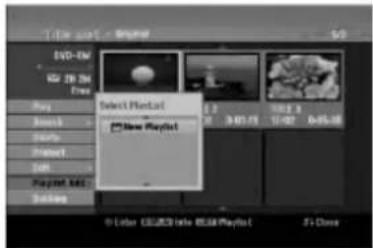
text_image
1 Day 20:00 - New Play S/O DVD-EN 42.29.3M Free Play Audio Audio Project Play Playout Mask Switching Select FlashList New Playlist 0.01.02 0.01.02 0.05.02 0.05.02 Color: RGB/RGB Scale: RGB/PlayList ST-Done- Select [New Playlist] then press ENTER. The new title appears in the updated Playlist. All chapters of the title are added to the Playlist.

text_image
DVD 1 02:19:56 Free TITLE 1 17:40 8:40:43 C:\Direct\CD3\Photo\CD3\Flash\ 5x CacheAdding Additional Title/Chapters to the Playlist -RWvr
You can add an Original title or chapter to add to a Playlist title even if it is already registered.
- Choose a title or chapter on the Title List-Original menu or Chapter List-Original menu to put into the Playlist, then press ENTER. The menu options appears on the left side of the screen.
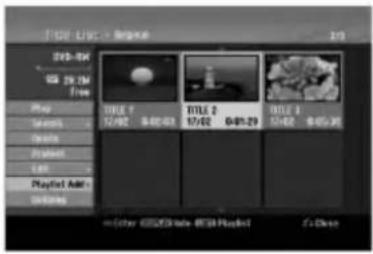
text_image
TUE - LIFC - 2000 DVD: 25V USB: 29.1M Free Play Sensors Details Project Last PlayFirst Adi: Switching TITLE 1 57/02 8:00:03 TITLE 2 57/02 8:05:29 TITLE 3 57/02 8:05:00 Enter 6000000x 8000000x Go-Deep- Use ▲ / ▼ to select [Playlist Add] from menu options then press ENTER.
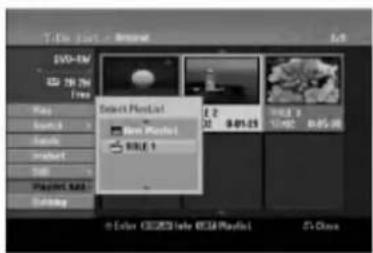
text_image
T-Box Start - Preview S.D. DVD-EN/ 19.2% Free Key Search Search Product Help Project and Helping Select PDF List and PDF List BBL 1 E 2 30 841.25 FBL 2 1000 845.00 ©Color: GE203 Save RGB/PlayList G-Clase-
Choose a Title List-Playlist that is already registered to insert a title or chapter, then press ENTER.
-
Repeat steps 1-3 to add additional title or chapter on the Playlist. You can view the added chapters on the Chapter List-Playlist menu.

text_image
Chapter List - Rayen TITLE 1 STAVE Fy: 34.338 @ Beach #508 Image On Clear- Press RETURN (♂) to exit, or MENU/LIST to go back to the Title List-Original menu.
Deleting an Original or Playlist Title/Chapter
When you erase a title or chapter from the Playlist menu, you only remove it from the Playlist; the title/chapter remains in the Original menu.
If you choose to delete a title or chapter from the Original (title/chapter) menu, the title or chapter is actually deleted from the disc and the remaining time available for recording increases. Titles/chapters deleted from the Original are also removed from the Playlist.
Note:
It may not be possible to delete chapters that are less than 5 seconds long.
-
Use ◀ / ▶ / ▲ / ▼ to choose a chapter or title you want to delete on the Title List or Chapter List menu then press ENTER. The menu options appears on the left side of the screen.
-
Select [Delete] option from the options on the menu.
Example: Title List (HDD)
- Press ENTER to confirm. The confirm message for deleting will appear.
- Use ◀ / ▶ to select [Yes] then press ENTER. The selected chapter or title is deleted. After pressing ENTER, the new, updated menu is displayed.
- Repeat steps 1 - 4 to continue to delete from the menu.
- Press RETURN (💡) repeatedly to exit the menu.
Notes:
- When DVD+RW recording, the deleted title's name is changed to 'Deleted Title'.
- If more than two titles are repeatedly deleted, the titles are combined into one.
- When you are deleting a title or chapter, only the last one on DVD+RW increases remaining recording time.
Deleting a Part HDD -RWvr
You can delete a part which you do not want in the title.
- Use ◀/▶/▲/▼ to choose a title you want to delete on the Title List menu then press ENTER. The options appears on the left side of the menu.
- Select [Delete Part] option then press ENTER. Edit (Delete Part) menu appears on the TV screen. [Start Point] icon is highlighted.
Example: Edit (Delete Part) (HDD)
text_image
Delete Part Start Panel Live Panel Show Image Cancen Save 0/17:4 16:52 10:00:00 HP 2.00.00 Color ▶ 30.00 ▶ More Point F-Clave- Starts playback and use pause step, search and slow-motion to find the starting point.
- Press ENTER at the starting point of the section you want to delete. 'End Point' icon is highlighted. The part is indicated on the Progress Bar.
- Use pause step, search and slow-motion to find the ending point.
- Press ENTER at the ending point of the section you want to delete. You can cancel the selected point, use ▲ / ▼ to select [Cancel] icon then press ENTER.
Tip:
With HDD recordings, you can delete additional part. Select [Next Part] icon on the menu then press ENTER, then repeat steps 3-6.
- If you finish to edit, select [Done] icon then press ENTER.
The confirm message for deleting will appear. Use ◀/▶ to select [Yes] then press ENTER. The selected part is deleted from the title and Title List menu appears.
Note:
It may not be possible to delete parts that are less than 3 seconds long.
Naming a Title
You can name Original and Playlist titles independently. Names can be up to 32 characters long.
- Choose the title you want to name on the Title List menu, then press ENTER. The menu options appears on the left side of the menu.
- Use ▲/▼ to select [Rename (Title Name)] option then press ENTER. Keyboard menu appears.
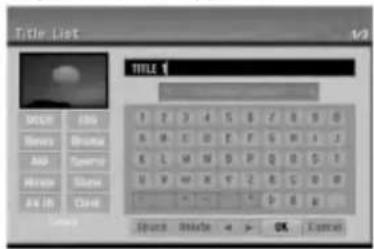
text_image
Title List TITLE DASH CLO BOMES BRINCE ADD TAWARIA HUMAN SHINE AVEN COLD 1 T 2 3 4 S B F G H I J S R E U F T S W I J K L M N O P Q Q D I U V W X Y Z R S R W - - - - - - - - - - - - - - - - - Shares Number OK Cancel-
Enter a name for the title. Use ◀/▶/▲/▼ to select a character then press ENTER to confirm your selection.
-
Use MENU/LIST button to change keyboard type.
- OK: Select to finish.
- Cancel: Cancels all entered characters.
• Space: Inserts a space at the cursor position. - Delete: Deletes the previous character at the cursor position.
• ◀ / ▶: Moves cursor to left or right.
Tip:
Remote control buttons for entering a name PLAY (▶): Inserts a space at the cursor position.
II (PAUSE/STEP): Deletes the after character at the cursor position.
■ (STOP), CLEAR: Deletes the previous character at the cursor position.
|◀◀ / ▶▶▶: Moves cursor to left or right.
Numbers (0-9): Enters the corresponding character at the cursor position.
Tip:
You can add the genre only for HDD title name.
- Choose OK then press ENTER to fix the name and return to the previous menu screen.
- Press RETURN (💡) repeatedly to exit the menu.
Notes:
- Names can be up to 32 characters long.
- For discs formatted on a different recorder, you will see only a limited character set.
- When recording on DVD-R, DVD+R or DVD+RW discs, the entered name is displayed on the DVD player only after finalization.
Time Search
HDD
-RWvr
-RWVideo
+RW -R +R
You can select start point of the title.
- Use ◀ / ▶ / ▲ / ▼ to choose a title on the Title List menu then press ENTER.
The options appears on the left side of the menu. - Select [Time] option then press ENTER.
[Search] menu appears on the TV screen. Example: Title List (HDD)
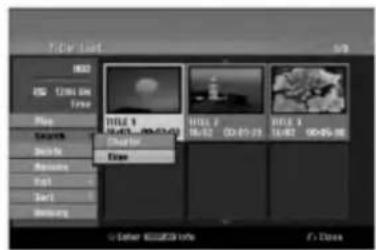
text_image
Video Player HOLD 100% 100% Live Show Search Details Actions End Start Helping HOLD 1 34:45 00:00:42 Shower Show HOLD 2 36:42 00:00:29 Shower 2 36:42 00:00:48 Shower 3 36:42 00:00:48 Other Broadcasts F- Class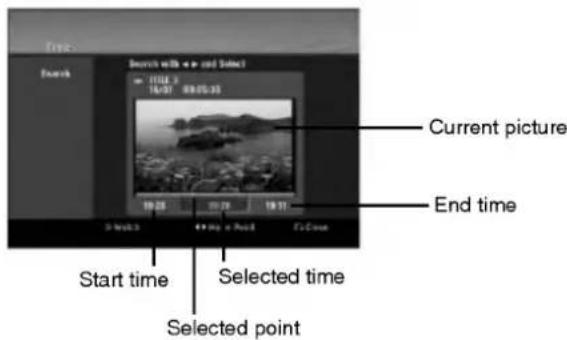
text_image
Search with 100% Select Current picture End time Start time Selected time Selected point-
Use ◀ / ▶ to find the point you want to start.
The point increase 1 minute step.
If you press and hold ◀ / ▶ then the point increase 5 minute step. -
Press ENTER to start selected point.
Sort HDD
This function allows you to access show listings organized by Date, Title, or Category on the Title List-HDD menu. So you can find title you want to watch easily.
- Choose any title on the Title List-HDD menu, then press ENTER.
The menu options appears on the left side of the menu. - Use ▲/▼ to select [Sort] option then press ENTER. Sort options appears.
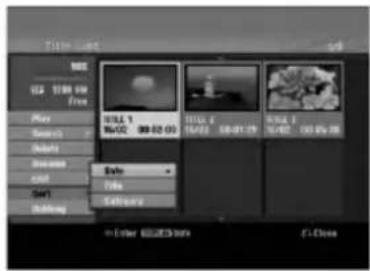
text_image
MOS 12:00:00 Free Play Search Selects Showers Add Set Adding WILL 1 No.02 09-03 03 Video Video Settings WILL 2 No.02 18-01 19 Video 2 No.02 18-05 18 Enter All Users C:\Users- Use ▲/▼ to select [Date], [Title] or [Category] option then press ENTER.
After pressing ENTER, the sorted menu is displayed.
Undoing/Redoing the Last Deletion -RWvr
If you make a mistake while deleting, you can undo it. There is one level of undo (in other words, you can undo the last one deletion you made).
Use ▲ / ▼ to select [Undo] option then press ENTER. It doesn't matter whether you are currently in the menu screen; the last deletion is undone.

text_image
T-Go List - Original DVD-M GS 29.16 Free Play Search Details Printed Help Weighted Preview BILE 1 BILE 2 BILE 3 0:47 0:45 0:45 0:47 0:45 0:45 Color ESCs/Blacks ESCs/Blacks E-ClanceNotes:
- You can't undo a recording.
- You can't undo anything after ejecting the disc from the recorder or switching the recorder into standby mode.
- You can still undo a deletion even after exiting the menu display.
Tip:
You can redo the last undo action using the [Redo] option.
Combining Two Titles Into One
HDD
Use this function to combine two adjacent Original-HDD titles into one.
Notes:
- This function is not available if there is only one titles within the HDD.
-
If there are more than 60 titles on the HDD, you cannot combine the titles.
-
On the Title List-HDD menu, select the first title of the two titles you want to combine then press ENTER.
The menu options appears on the left side of the screen.
- Select [Combine] option then press ENTER.
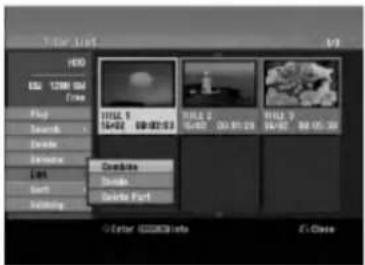
text_image
7 For Last HDD ED: 1200.0M Free Plug Search Details Balance Left Mount Setting HOLD 5 14:02 08:02:13 HOLD 2 14:02 20:01:19 HOLD 9 14:02 08:05:30 Addlist Delete Delete Paste Part Enter Addlistets F-Case-
Select the second title of the two titles you want to combine then press ENTER. Confirm message appears.
-
Use ◀ / ▶ to select [Yes] then press ENTER. After pressing ENTER, the updated menu is displayed.
Divide One Titles Into Two
HDD +RW
Use this command to split a title up into two new titles.
-
On the Title List menu, select a title you want to divide then press ENTER. The menu options appears on the left side of the screen.
-
Select [Divide] option. Example: Title List (HDD)
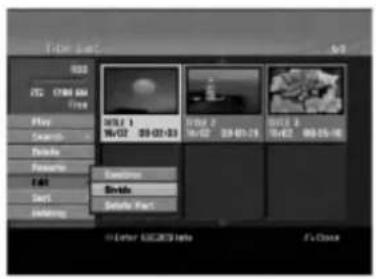
text_image
000 25 078 AM Free Play Search Balance Balance End Sett Delisting 34/12 1 No.02 09-01-03 Balance 2 No.02 09-01-15 Balance 3 No.02 09-01-16 Balance Balance Balance Balance End @Enter ESCRED Info F-Close- Press ENTER. Edit (Divide) menu appears. [Divide] option is highlighted.

text_image
Current picture The first title's thumbnail The second title's thumbnail-
Use play, pause step, search and slow-motion to find the point you want to divide the title.
-
Select [Divide] option then press ENTER at the point. To reset the point, select [Cancel] option then press ENTER. Repeat from step 3.
-
Choose [Done] option then press ENTER to fix the dividing point. The title is divided into two new titles. It take up to 4 minutes to divide.
Note:
You cannot select dividing point less than 3 seconds.
Combining Two Chapters Into
One HDD -RWvr +RW +R
Use this function to combine two adjacent Playlist or Original chapters into one.
Note:
This function is not available if there is only one chapter within the title.
-
On the Chapter List menu, select the second chapter of the two chapters you want to combine then press ENTER The menu options appears on the left side of the screen.
-
Use ▲ / ▼ to select [Combine] option. The combine indicator appears between the two chapters you want to combine.
text_image
Chapter 1:0 TITLE 6 15/02 24:33 Play Title Cramble C Eater F-Dress- Press ENTER.
Moving a Playlist Chapter
-RWVR
Use this function to re-arrange the playing order of Playlist chapters on the Title List-Playlist menu.
Note:
This function is not available if there is only one chapter.
- Select a chapter on the Chapter List-Playlist menu.
- Press ENTER.
The menu options appears on the left side of the menu. - Use ▲ / ▼ to select [Move] option from Playlist options then press ENTER.
text_image
Chapter List - Plot HOLD 1 SIZE 20: 3M 320 Play Title Balance Balance Balance G Select 1 WSSB Preview G Close- Use ◀ / ▶ / ▲ / ▼ to choose the place you want to move the chapter to then press ENTER. After pressing ENTER, the updated menu is displayed.
Hide a Chapter/Title +RW +R
You can skip playing chapters or titles without deleting from the disc.
-
Use ▲▼◀▶ to choose a chapter or title you want to hide on the Title List or Chapter List menu, then press ENTER.
Options appear on the left side of the screen. -
Select [Hide] option.
Example: Title List (DVD+RW)

text_image
EVI-EM EVI 19.00 Time Play Full Play Search Show Project Edit Preview TITLE: 5 17/02 04:03:03 TITLE: 2 17/02 01:13:03 TITLE: 3 17/02 01:25:00 Title Name Title Make Select: 852565676 Go Cross- Press ENTER to confirm.
The chapter's or title's thumbnail will dim.
Tip
If you select a hidden chapter or title on the Title List or Chapter List menu, you can 'show' it by choosing [Show] option on the menu. After doing that, you are able to see the chapter or title.
Protect a Title
+RW +R -RWvr
Use this function to protect against accidental recording, editing or deleting of the title.
- Press MENU/LIST to display the Title List menu.
- Use ▲▼◀▶ to choose a title you want to protect then press ENTER.
Options appear on the left side of the screen. - Select [Protect] from the options.

text_image
Time: 1st - August DST-Zel AS: 29.154 Free Play Search Index Project Lock Honeyd Jink Subdiving WELL 1 17:02 BEEY-03 WELL 2 17:03 A:01:13 HILL 3 17:02 B:05:13 Color: RGB/Video RGB/Playlist C:\Users- Press ENTER to confirm.
The lock mark will appears on the title's thumbnail.
Tip
If you select a title that has already been protected on the Title List menu, you can 'unprotect' it by choosing [Protect] option from the Title List menu options. After doing that, you can edit and delete the title.
Dubbing
Before Dubbing
Use the copying features of this recorder to:
- Back up important recordings stored on the HDD to a DVD.
- Make a DVD copy of a recording on the HDD to play in another player.
- Transfer video from a DVD to the HDD for editing.
- Transfer edited video from the HDD to DVD.
The simplest method of copying is to use the One Touch Copy feature. Using this you can very simply copy the title that's currently playing from HDD to DVD, or the other way around.
Note:
If the title's length is less than 5 seconds, the dubbing is not available. (from HDD to DVD)
Restrictions on copying
Some video material is copy-once protected: Such material cannot be copied to HDD or DVD.
You can identify copy-once protected material during playback by displaying disc information on-screen.
- NTSC format signals from the analog or the DV inputs is not recorded correctly with this recorder.
- Video signals in SECAM format (from the built-in TV tuner or from the analog inputs) are recorded in PAL format.
What is 'CPRM'?
CPRM is a copy protection system (with scramble system) only allowing the recording of 'copy once' broadcast programs. CPRM stands for Content Protection for Recordable Media.
CPRM recordings can only be made on DVD-RW discs formatted in VR mode or discs, and CPRM recordings can only be played on players that are specifically compatible with CPRM.
Copyright
- Recording equipment should be used only for lawful copying and you are advised to check carefully what is lawful copying in the area in which you are making a copy. Copying of copyright material such as films or music is unlawful unless permitted by a legal exception or consented to by the rights owner.
- This product incorporates copyright protection technology that is protected by method claims of certain U.S. patents and other intellectual property rights owned by Macrovision Corporation and other rights owners. Use of this copyright protection technology must be authorized by Macrovision Corporation, and is intended for home and other limited viewing uses only, unless otherwise
authorized by Macrovision corporation. Reverse engineering or disassembly is prohibited.
- CONSUMERS SHOULD NOTE THAT NOT ALL HIGH DEFINITION TELEVISION SETS ARE FULLY COMPATIBLE WITH THIS PRODUCT AND MAY CAUSE ARTIFACTS TO BE DISPLAYED IN THE PICTURE. IN CASE OF 625 PROGRESSIVE SCAN PICTURE PROBLEMS, IT IS RECOMMENDED THAT THE USER SWITCH THE CONNECTION TO THE 'STANDARD DEFINITION' OUTPUT. IF THERE ARE QUESTIONS REGARDING OUR TV SET COMPATIBILITY WITH THIS MODEL 625p HDD/DVD RECORDER, PLEASE CONTACT OUR CUSTOMER SERVICE CENTER.
Fast copying (Maximum 12x)
Copying between DVD and HDD is a completely digital process and therefore involves no loss of quality in the audio or video. This means that you can transfer back and forth without having to worry about the quality getting worse with each copy 'generation'. It also means that copying can be carried out at the maximum speed possible.
When copying from HDD to DVD, the speed of copying depends on the recording mode and the kind of DVD disc you're using.
Minimum fast copying times
The table below shows the minimum HDD to DVD copying time for 2 hours of video recorded with SP mode.
| Disc Type | Disc Speed | Copying Time (Record Speed) |
| DVD-R / DVD+R | 16x | 6.5 min. (12x) |
| DVD-R / DVD+R / DVD+RW | 8x | 8 min. (8x) |
| DVD+R DL | 8x | 13 min. (4x) |
| DVD-RW | 6x | 12 min. (6x) |
| DVD-R / DVD+RDVD-RW / DVD+RW | 4x | 13 min. (4x) |
| DVD+R / DVD+RW / DVD+R DL | 2.4x | 21 min. (2.4x) |
| DVD-R / DVD-RW | 2x | 25 min. (2x) |
Notes:
- All times in the above table are approximate.
- Actual copy speed varies with the part of the disc being recorded.
- There may be cases where even 4x/6x/8x/16x compatible discs do not copy at full speed.
- Fast copying may not be possible when using disc initialized on another recorder.
Dubbing from HDD to DVD
- On the Title List-HDD menu, select a title you want to dub then press ENTER. The menu options appears on the left side of the screen.
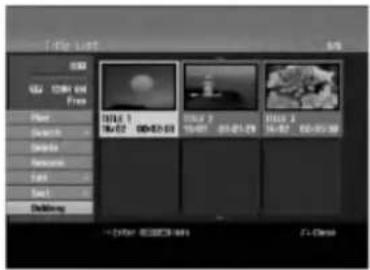
text_image
File List 03 128-000 Free Time 1 16:02 00:00:00 Time 2 16:07 01:01:29 Time 3 16:02 01:01:30 Default Balance Set Delining +Enter OK/OK/OK +Close- Use ▲ / ▼ to select [Dubbing] option then press ENTER. Dubbing menu appears.
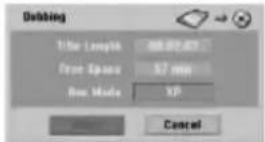
- Use ◀ / ▶ to select record mode (XP, SP, LP, EP, or Fast), then press ▼. 'Start' icon is highlighted. Fast: See page 49 for more information on Fast copying.
- When [Start] icon is highlighted, press ENTER. Dubbing starts.
- To stop dubbing at any other time, press STOP (■).
Notes:
- The recording time of [Fast] mode could be varied depending on data size of source.
- Stopping dubbing in [Fast] mode partway through will cancel the recording and any data recorded up to that point will be lost.
- If the remaining space on the disc is insufficient, the [Fast] mode is not available.
- The [Fast] mode is not available for edited HDD title and Clip Recording title.
Dubbing from DVD to HDD
- On the Title List menu, select a title you want to dub then press ENTER. Menu options appears on the left side of the screen.
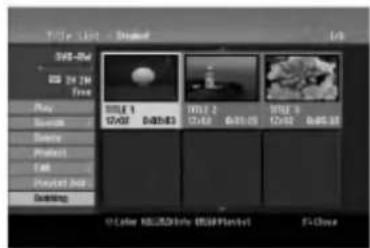
text_image
Play Sound Source Project Fall Project Auto Outstanding 10/07 5:45:43 10/07 6:45:49 10/07 8:45:49 ©Color MACROVics (MILF) [Movie] F-Clance- Use ▲ / ▼ to select [Dubbing] option then press ENTER. Dubbing menu appears.
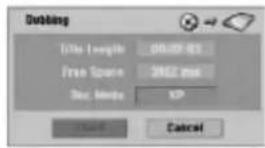
- Use ◀ / ▶ to select record mode (XP, SP, LP, EP, or Fast), then press ▼. 'Start' icon is highlighted. Fast: Only available when copying VR mode disc to HDD. (See page 49 for more information on Fast copying.)
- When [Start] icon is highlighted, press ENTER. Dubbing starts.
- To stop dubbing at any other time, press STOP (■).
Notes:
- Depending on the conditions of the recording equipment or the disc itself, the dubbing may not be capable.
- Stopping dubbing in [Fast] mode partway through will cancel the recording and any data recorded up to that point will be lost.
- The recording time of [Fast] mode can take up to 19 minutes.
- The [Fast] mode is not available for edited title on the DVD-RW with VR recording mode.
One Touch Copy (HDD to DVD)
The One Touch Copy feature copies the currently playing title from the HDD to DVD. The whole title is copied, regardless of where in the title you start copying. The recorder copies at the maximum speed possible.
For One Touch Copy to work, make sure that a recordable DVD disc is loaded.
During HDD playback, press DUBBING to copy the current title to DVD.
The on-screen display indicates that the title is being copied. Playback continues while copying.
- You cannot use the One Touch Copy function to copy a title if any part of the title is copy-once protected.

text_image
3%One Touch Copy (DVD to HDD)
One Touch Copy from DVD to HDD copies a single title to the HDD in real time. When you start copying, playback jumps back to the start of the title, then continues through to the end of the title, when recording automatically stops. The copy will be made in the recording mode (XP, SP, LP, EP) that is currently set.
During DVD playback, press DUBBING to copy the current title to HDD.
Playback starts again from the beginning of the current title. The on-screen display indicates that the title is being copied.

text_image
15%Notes:
• Video CD cannot be copied to HDD.
- The copying stops when then recorder detects a badly scratched or copy protected part.
- If some part of the title being copied is copy-protected, copying will start, but the copy-protected portions will not be copied.
- During Playlist title's playback, One Touch Copy is not available.
Tip:
To stop dubbing at any other time, press STOP (■).
Reference
Additional Information
Overwriting Recording +RW
To overwrite a new video recording on a previously recorded title, follow these steps. This feature is not available for DVD+Rs, that always record at the end of the Disc.
- Select input source you want to record (TV channel, AV1-4, DV).
- Press MENU/LIST to display the Title List menu.

text_image
SVD-8M 320 750.0m Free HOLD 1 5/4/02 0:00:00 HOLD 2 5/4/02 0:00:29 HOLD 3 5/4/02 0:00:00 Empty Time 2:00:00 © Date © Display Date © Date F:\Close- Use ▲▼◀▶ to choose a title you want to overwrite.
- Press REC (●) to start overwrite recording. Overwrite recording starts from the start point of the title.
- Press STOP (■) to stop the overwrite recording. The new title is created and updated menu is displayed.
Notes:
• This function is not available for a protected title.
- If the overwrite is longer than the recording length of the current title, the next title is overwritten. But if next title is protected, the overwriting stops at the starting point of the title.
- If the selected title's recording length is less than 10 seconds, the next title is overwritten. But if the next title is protected, overwriting stops.
Viewing Title List menu displayed on other DVD Recorders or Players
+RW +R
You can view the Title List menu displayed on the other DVD player that is capable of playing DVD+RW or DVD+R discs.
-
Insert DVD+R or DVD+RW disc recorded already.
-
Press TITLE in play or stop mode. Title List menu will appear as shown below.
Tip You can remove the Title List menu by pressing STOP (■).

text_image
215-097 01.2 1 13:2 04:24 01.2 1 02:2 0.01.28 01.2 3 15:2 0.05.28 Play TVE OK 1/1 >S- To play back a title, select the title you want then press ENTER or PLAY (▶).
Playing Your Recordings on Other DVD Players (Finalizing a Disc)
Most regular DVD players can play finalized discs recorded in Video mode, finalized DVD+R or DVD+RWs. A small number of players can also play DVD-RW discs recorded in VR mode, finalized or not. Check the manual that came with the other player to check what formats of discs it will play.
Finalizing 'fixes' the recordings and editings in place so that the disc can be played on a regular DVD player or computer equipped with a suitable DVD-ROM drive.
Finalizing a Video mode disc creates a menu screen for navigating the disc. The menu can be accessed by pressing MENU/LIST or TITLE.
To finalize a disc, refer to "Finalize" on page 21.
Notes:
- Unfinalized DVD+RW is playable on regular DVD players.
- The edited contents of a DVD+RW disc is compatible on regular DVD players only after finalization.
- Any edited contents of the DVD+R disc are not compatible on regular DVD players. (Hide, chapter combine, added chapter mark, etc.)
- How long finalization takes depends on the type of disc, how much is recorded on the disc, and the number of titles on the disc.
- DVD+R DL disc can take up to 30 minutes to finalize.
Language Codes
Use this list to input your desired language for the following initial settings:
Disc Audio, Disc Subtitle, Disc Menu.
| Language | Code | Language | Code | Language | Code | Language | Code |
| Abkhazian | 6566 | Fiji | 7074 | Lingala | 7678 | Singhalese | 8373 |
| Afar | 6565 | Finnish | 7073 | Lithuanian | 7684 | Slovak | 8375 |
| Afrikaans | 6570 | French | 7082 | Macedonian | 7775 | Slovenian | 8376 |
| Albanian | 8381 | Frisian | 7089 | Malagasy | 7771 | Somali | 8379 |
| Ameharic | 6577 | Galician | 7176 | Malay | 7783 | Spanish | 6983 |
| Arabic | 6582 | Georgian | 7565 | Malayalam | 7776 | Sudanese | 8385 |
| Armenian | 7289 | German | 6869 | Maltese | 7784 | Swahili | 8387 |
| Assamese | 6583 | Greek | 6976 | Maori | 7773 | Swedish | 8386 |
| Aymara | 6588 | Greenlandic | 7576 | Marathi | 7782 | Tagalog | 8476 |
| Azerbaijani | 6590 | Guarani | 7178 | Moldavian | 7779 | Tajik | 8471 |
| Bashkir | 6665 | Gujarati | 7185 | Mongolian | 7778 | Tamil | 8465 |
| Basque | 6985 | Hausa | 7265 | Nauru | 7865 | Tatar | 8484 |
| Bengali; Bangla | 6678 | Hebrew | 7387 | Nepali | 7869 | Telugu | 8469 |
| Bhutani | 6890 | Hindi | 7273 | Norwegian | 7879 | Thai | 8472 |
| Bihari | 6672 | Hungarian | 7285 | Oriya | 7982 | Tibetan | 6679 |
| Breton | 6682 | Icelandic | 7383 | Panjabi | 8065 | Tigrinya | 8473 |
| Bulgarian | 6671 | Indonesian | 7378 | Pashto, Pushto | 8083 | Tonga | 8479 |
| Burmese | 7789 | Interlingua | 7365 | Persian | 7065 | Turkish | 8482 |
| Byelorussian | 6669 | Irish | 7165 | Polish | 8076 | Turkmen | 8475 |
| Cambodian | 7577 | Italian | 7384 | Portuguese | 8084 | Twi | 8487 |
| Catalan | 6765 | Japanese | 7465 | Quechua | 8185 | Ukrainian | 8575 |
| Chinese | 9072 | Javanese | 7487 | Rhaeto-Romance | 8277 | Urdu | 8582 |
| Corsican | 6779 | Kannada | 7578 | Rumanian | 8279 | Uzbek | 8590 |
| Croatian | 7282 | Kashmiri | 7583 | Russian | 8285 | Vietnamese | 8673 |
| Czech | 6783 | Kazakh | 7575 | Samoan | 8377 | Volapük | 8679 |
| Danish | 6865 | Kirghiz | 7589 | Sanskrit | 8365 | Welsh | 6789 |
| Dutch | 7876 | Korean | 7579 | Scots Gaelic | 7168 | Wolof | 8779 |
| English | 6978 | Kurdish | 7585 | Serbian | 8382 | Xhosa | 8872 |
| Esperanto | 6979 | Laothian | 7679 | Serbo-Croatian | 8372 | Yiddish | 7473 |
| Estonian | 6984 | Latin | 7665 | Shona | 8378 | Yoruba | 8979 |
| Faroese | 7079 | Latvian, Lettish | 7686 | Sindhi | 8368 | Zulu | 9085 |
Area Codes
Choose an area code from this list.
| Area | Code | Area | Code | Area | Code | Area | Code |
| Afghanistan | AF | Ethiopia | ET | Malaysia | MY | Saudi Arabia | SA |
| Argentina | AR | Fiji | FJ | Maldives | MV | Senegal | SN |
| Australia | AU | Finland | FI | Mexico | MX | Singapore | SG |
| Austria | AT | France | FR | Monaco | MC | Slovak Republic | SK |
| Belgium | BE | Germany | DE | Mongolia | MN | Slovenia | SI |
| Bhutan | BT | Great Britain | GB | Morocco | MA | South Africa | ZA |
| Bolivia | BO | Greece | GR | Nepal | NP | South Korea | KR |
| Brazil | BR | Greenland | GL | Netherlands | NL | Spain | ES |
| Cambodia | KH | Heard and McDonald Islands | HM | Netherlands Antilles | AN | Sri Lanka | LK |
| Canada | CA | Hungary | HU | New Zealand | NZ | Sweden | SE |
| Chile | CL | India | IN | Nigeria | NG | Switzerland | CH |
| China | CN | Indonesia | ID | Norway | NO | Thailand | TH |
| Colombia | CO | Israel | IL | Oman | OM | Turkey | TR |
| Congo | CG | Italy | IT | Pakistan | PK | Uganda | UG |
| Costa Rica | CR | Jamaica | JM | Panama | PA | Ukraine | UA |
| Croatia | HR | Japan | JP | Paraguay | PY | United States | US |
| Czech Republic | CZ | Kenya | KE | Philippines | PH | Uruguay | UY |
| Denmark | DK | Kuwait | KW | Poland | PL | Uzbekistan | UZ |
| Ecuador | EC | Libya | LY | Portugal | PT | Vietnam | VN |
| Egypt | EG | Luxembourg | LU | Romania | RO | Zimbabwe | ZW |
| El Salvador | SV | Russian Federation | RU |
Controlling Your TV with the Supplied Remote Control
You can control the sound level, input source, and power switch of your LG TV with the supplied remote.
You can control your TV using the buttons below.
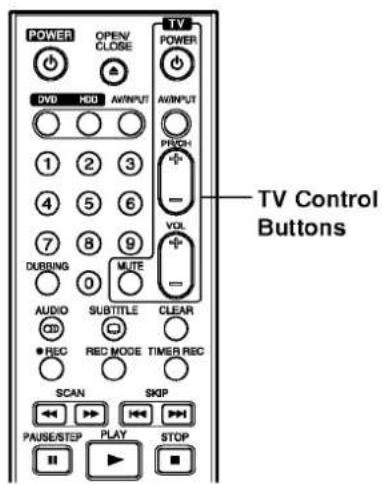
text_image
TV Control Buttons POWER OPEN/ CLOSE TV POWER DVD HDD AVINPUT AVINPUT 1 2 3 4 5 6 7 8 9 DUBBING MUTE AUDIO SUBTITLE CLEAR ● REC REC MODE TIMER REC SCAN SKIP PAUSE/STEP PLAY STOP| By pressing | You can |
| POWER | Turn the TV on or off. |
| AV/INPUT | Switch the TV's input source between the TV and other input sources. |
| PR/CH +/- | Scans up or down through memorized channels. |
| VOL +/- | Adjust the volume of the TV. |
| MUTE | Temporarily turns TV sound OFF, press again to restore. |
Controlling other TVs with the remote
You can control the sound level, input source, and power switch of non-LG TVs as well. If your TV is listed in the table below, set the appropriate manufacturer code.
-
While holding down TV POWER button, press the number buttons to select the manufacturer code for your TV (see the table below).
-
Release TV POWER button.
Code numbers of controllable TVs
If more than one code number is listed, try entering them one at a time until you find the one that works with your TV.
| Manufacturer | Code Number |
| LG / GoldStar | 1 (Default), 2 |
| Zenith | 1, 3, 4 |
| Samsung | 6, 7 |
| Sony | 8, 9 |
| Hitachi | 4 |
Notes:
- Depending on your TV, some or all buttons may not function on the TV, even after entering the correct manufacturer code.
- If you enter a new code number, the code number previously entered will be erased.
- When you replace the batteries of the remote, the code number you have set may be reset to the default setting. Set the appropriate code number again.
Troubleshooting
Check the following guide for the possible cause of a problem before contacting service.
| Symptom | Cause | Solution |
| No power. | The power cord is disconnected. | Plug the power cord into the wall outlet securely. |
| No picture. | TV/DVD mode for the recorder is set to TV. | Press TV/DVD on the remote control repeatedly to choose DVD mode. TV indicator disappears in the display window. |
| The TV is not set to receive recorder signal output. | Select the appropriate video input mode on the TV so the picture from the recorder appears on the TV screen. | |
| The video cable is not connected securely. | Connect the video cable securely. | |
| The connected TV power is turned off. | Turn on the TV. | |
| No sound. | The equipment connected with the audio cable is not set to receive recorder signal output. | Select the correct input mode on the audio receiver so you can listen to the sound from the recorder. |
| The audio cables are not connected securely. | Connect the audio cable securely. | |
| The power of the equipment connected with the audio cable is turned off. | Turn on the equipment connected with the audio cable. | |
| The audio connecting cord is damaged. | Replace it with new one. | |
| The playback picture is poor. | The disc is dirty. | Clean the disc. |
| The recorder does not start playback. | No disc is inserted. | Insert a disc. (Check that the disc indicator in the display window is lit.) |
| An unplayable disc is inserted. | Insert a playable disc. (Check the disc type, color system, and regional code.) | |
| The disc is placed upside down. | Place the disc with the playback side down. | |
| The disc is not placed within the guide. | Place the disc on the disc tray correctly inside the guide. | |
| The disc is dirty. | Clean the disc. | |
| The Rating level is set. | Cancel the Rating function or change the rating level. | |
| The picture from the external input is distorted | The video signal from the external component is copy-protected. | You cannot connect via this recorder. Connect the component directly to your TV. |
| Some channels are skipped over when using PR/CH (+/-). | Those channels are not stored in the recorder. | Restore channels. See “Program Edit” on page 16. |
| The picture or sound of broadcasting channel is weak or missing. | Aerial or cables are loose. | Tighten connections or replace cable. |
| Camcorder image is not shown. | Camcorder is off. | Turn camcorder on and operate properly. |
| Camcorder image via A/V input or DV IN to recorder is not shown on TV screen. | The recorder's source is incorrect. | Use AV/INPUT to select input channel (AV1, AV2, DV, etc.) |
| Cannot play a disc recorded using this recorder on another player. | The disc was recorded in Video mode. | Finalize the disc. (page 21) |
| Some players will not play even a finalized disc recorded in Video mode. | No solution. | |
| The disc was recorded in VR mode, | The other player must be RW compatible in order to play it. | |
| Discs recorded with copy-once material cannot be played on other players. | No solution. | |
| Cannot record or did not record successfully. | The remaining blank space on the disc is insufficient. | Use another disc. |
| The source you are trying to record is copy protected. | You cannot record the source. | |
| When setting the recording channel, the channel is tuned on the TV's own tuner. | Select the channel on the recorder's built-in TV tuner. | |
| When recording to a Video mode disc, programs that are copy-once protected cannot be recorded. | Use a VR mode formatted disc for copy-once material. | |
| Timer recording is not possible. | Clock in recorder is not set to correct time. | Set clock to correct time. See "Auto Clock Set" or "Manual Clock Set" on page 17. |
| Timer has been programmed incorrectly. | Reprogram Timer. See "Timer Recording" on page 37. | |
| Timer record indicator light does not appear after programming timer. | Reprogram Timer. | |
| Stereo Audio Record and/or Playback is not present. | TV is not Stereo-compatible. | No solution. |
| Broadcast program is not in stereo format. | No solution. | |
| The recorder A/V Out jacks are not connected to TV A/V In jacks. | Make A/V connections. Stereo is available only via A/V output from the recorder. | |
| The recorder Audio/Video Out is not selected for viewing at the TV. | Select AUX or A/V source as TV input. | |
| The recorder's TV audio channel is set to mono. | Set TV audio channel mode to Stereo. See "Changing TV audio channel" on page 36. | |
| The remote control does not work properly. | The remote control is not pointed at the remote sensor of the recorder. | Point the remote control at the remote sensor of the recorder. |
| The remote control is too far from the recorder. | Operate the remote control within 7 m. | |
| There is an obstacle in the path of the remote control and the recorder. | Remove the obstacle. | |
| The batteries in the remote control are exhausted. | Replace the batteries with new ones. |
Resetting the recorder
If you observe any of the following symptoms...
- The unit is plugged in, but the power will not turn on or off.
- The front panel display is not working.
• The recorder is not operating normally.
...you can reset the recorder as follows:
- Press and hold the POWER button for at least five seconds. This will force the unit to power off then turn the unit back on.
- Unplug the power cord, wait at least five seconds, and then plug it in again.
Specifications
General
| Power requirements | AC 200-240V, 50/60 Hz |
| Power consumption | 35W |
| Dimensions (approx.) | 430 X 54 X 275 mm (w x h x d) without foot |
| Mass (approx.) | 4.1 kg |
| Operating temperature | 5°C to 35°C |
| Operating humidity | 5 % to 90 % |
| Television system | PAL I, B/G, I/I, SECAM D/K, K1 color system |
| Recording format | PAL |
Recording
| Recording format | DVD Video Recording, DVD-VIDEO |
| Recordable media | HDD (80GB), DVD-ReWritable, DVD-Recordable, DVD+ReWritable, DVD+Recordable, DVD+Recordable (Double Layer) |
| Recordable time | DVD (4.7GB): Approx. 1 hour (XP mode), 2 hours (SP mode), 4 hours (LP mode), 6 hours (EP mode) |
| DVD+R DL (8.5GB): Approx. 3 hour (XP mode), 3 hours 40 minutes (SP mode), 7 hours 10 minutes (LP mode), 10 hours 30 minutes (EP mode) | |
| HDD (80GB): Approx. 20 hours (XP mode), 40 hours (SP mode), 74 hours (LP mode), 111 hours (EP mode) |
Video recording format
| Sampling frequency | 27MHz |
| Compression format | MPEG 2 (VBR support) |
| Audio recording format | |
| Sampling frequency | 48kHz |
| Compression format | Dolby Digital |
Playback
| Frequency response | DVD (PCM 48 kHz): 8 Hz to 22 kHz, CD: 8 Hz to 20 kHz |
| DVD (PCM 96 kHz): 8 Hz to 44 kHz | |
| Signal-to-noise ratio | More than 100 dB (AUDIO OUT connector) |
| Harmonic distortion | Less than 0.008% (AUDIO OUT connector) |
| Dynamic range | More than 95 dB (AUDIO OUT connector) |
Inputs
| AERIAL IN | Aerial input, 75 ohms |
| VIDEO IN | 1.0 Vp-p 75 ohms, sync negative, RCA jack x 2 / SCART x 2 |
| AUDIO IN | 2.0 Vrms more than 47 kohms, RCA jack (L, R) x 2 / SCART x 2 |
| S-VIDEO IN | (Y) 1.0 V (p-p), 75 Ω, sync negative, Mini DIN 4-pin x 1(C) 0.3 V (p-p) 75 Ω |
| DV IN | 4 pin (IEEE 1394 standard) |
Outputs
| VIDEO OUT | 1 Vp-p 75 Ω, sync negative, RCA jack x 1 / SCART x 2 |
| S-VIDEO OUT | (Y) 1.0 V (p-p), 75 Ω, sync negative, Mini DIN 4-pin x 1(C) 0.3 V (p-p) 75 Ω |
| COMPONENT VIDEO OUT | (Y) 1.0 V (p-p), 75 Ω, sync negative, RCA jack x 1(Pb)/(Pr) 0.7 V (p-p), 75 Ω, RCA jack x 2 |
| Audio output (digital audio) | 0.5 V (p-p), 75 Ω, RCA jack x 1 |
| Audio output (optical audio) | 3 V (p-p), Optical connector x 1 |
| Audio output (analog audio) | 2.0 Vrms (1 KHz, 0 dB), 600 Ω, RCA jack (L, R) x 1 / SCART x 2 |
Accessory:
| Scart cable | 1 | RF Coaxial Cable | 1 |
| Remote control | 1 | Batteries | 2 |
- Design and specifications are subject to change without notice.
P/NO:3834RD0088G